As George and Ernie are both out on manoeuvres, and because last week's bumper edition nearly finished me off, we're having a rest from Namesakes this week. All being well, it will return to bore you next Tuesday.
At the weekend, Louise and I went to see the new stage adaptation of To Kill A Mockingbird. It was excellent. I've long been a fan of Aaron Sorkin's sparky, snappy dialogue, and he found some excellent ways to use the themes of the novel to say important (if ultimately futile) things about the state of America today. If it comes to your neck of the woods, I'd highly recommend going along to see it.
Here are some tunes related, in one way or another, to Harper Lee's famous novel...
Ben bought me the C86 book by Nige Tassell last Christmas and I finally got around to starting it over the summer. It's an absorbing read, with a chapter devoted to every band who featured on the NME's legendary C86 cassette, catching up with them, finding out where they are and what they're up to now. Beyond the ones that are obviously still around - like Primal Scream, The Wedding Present and Half Man Half Biscuit - many of the others are still involved in music in one form or another, and most (with the exception of Bobby Gillespie, natch) are very down to earth about it.
Most music books deal with the big names, the stadium giants who live a life we can't imagine and talk about music like it's a kind of alchemy (and I guess if it takes you to that level of success, it is). The interviews here feature everyday people having a cup of tea in their front room, walking their dog in a graveyard, or getting up early to go bird-watching... and as such, it demystifies the music industry and you realise that pop stars are just like you and me. Some of them get lucky, but most of them enjoy (or completely bungle) their 15 minutes and then shuffle off to get on with the rest of their lives. Amusingly, quite a few of the bands lament the song they chose for the C86 compilation, saying they feel they had far better tracks to offer, but either didn't realise how significant C86 was going to be or just couldn't be bothered. (Stump, for example, blew most of the £500 the NME gave them on nights out, then recorded a really crappy version of one of their best tunes which didn't do it any justice.)
Although I'm not even halfway through the book due to my usual snail's pace at reading anything these days, the most interesting observation thus far came from Dave Newton of the Mighty Lemon Drops who was explaining why he thought his band went on to enjoy more success in the States (where he now lives) than in their home country. He put this squarely down to what he calls "tribalism"...
"Over here, it's amazing how many people who like us or the Bunnymen also like Van Halen. I don't get that. Some Americans think I'm not telling the truth about bands like that - or that I'm some kind of snob. No, it's just not conceivable that in the UK you'd like Wah! Heat and Bon Jovi. But you see it here on kids' schoolbags where they've written both Rush and the Sex Pistols. Really?! How can you love both?"
And as soon as I read this, I realised where I went wrong as a kid. And where I still go wrong today, as a blogger. The closest I can get to tribalism is to say that I don't really care for dance music post 1987, but I think that's more to do with the way I process music - lyrics first. When I was a kid, I liked most pop and rock music, from any era. Then, as I began to discover alternative music, I kept on enjoying all the other stuff. I didn't go off down one path and close the door to all the other stuff. And while I wasn't cool enough to be buying the NME when C86 came out, one thing that surprised me from reading the book was how many of the bands didn't really see themselves as particularly alternative anyway, they just wanted to make pop music and have a good time.
Anyway, I figure this is why the musos don't get me, and why this blog will never really find its niche. Because one day I might be writing about Pulp, and the next I'll be writing about Barry Manilow. And there's no distinction in my head. If I like something, I like it. And all these years, I've been made to feel guilty about that, like it's a bad thing. Maybe I should have grown up in the states...
I bought this for Louise on Mother's Day. He crushed it with his own feet.
Someone at work asked, "Is Louise a big fan?" No. That's why it was funny.
Earlier in the week, Martin blogged about his experiments with ChatGPT, the new AI chatbot that's about to replace human "experts" across the world. We all agreed how scary this was. I commented that it reminded me of Dave Eggers' firm belief that society is moving towards handing over freedom of choice in return for the safety of conformity.
Here's another extract from The Every, a novel which is best described as 1984 meets Catch 22 with a healthy dollop of Gulliver's Travels. Yes, it's satire... but so close to reality that it's hard to work out which bits are true and which bits Eggers has created for comic effect.
In the following extract,
Delaney has gone to work for the HereMe department which creates Smart Speakers.
Eggers uses this as an excuse to chronicle the secret history of Smart
Speakers, which sounds like fiction… until you realise we’ve already lived
through much of it.
Smart speakers had an awkward introduction to the world.
They arrived in the 2010s to phenomenal sales, with hundreds of millions of
households adopting them within the first five years. Before The Every entered
the picture, the makers of the devices assured the buyers that the AI
assistants were never activated unless their designated name or code word was
spoken. This reassured the users that their private everyday conversations were
not being heard, that only brief requests were audible, and even then, never
stored. But a few months later, it was revealed that the smart speakers were in
fact listening all the time, or could
listen all the time. In fact, they could be activated by their manufacturers
any time at all. For this, the manufacturers apologised; perhaps there had been
some confusion, they said. Were we unclear?
The users, though momentarily upset at this foundational and
central deception, were assuaged when they were told that under no
circumstances were their conversations recorded.
It would be, both users and manufacturers agreed, an egregious breach of trust
to have a machine that a customer brought into their house – a machine,
everyone noted, that was purchased primarily to play music and inform them of
the current traffic – actually recording
the conversations conducted in these private households. That would be
unethical. And so it was assumed that no recording was being done by these home
assistants, until one day the manufacturers admitted that they had in fact been
recording just about every conversation every user had ever had, from the very
beginning.
Again the makers were contrite. When you were asking before
about whether we were recording conversations, they said, we didn’t quite
understand what you meant. We thought you meant recording and listening to these conversations, and
that of course we would never do. We would never.
We record the conversations of hundreds of millions of users, yes, but no
humans ever listen to any of these conversations. Conversations in the home,
between family members, are private, are sacrosanct! they said. We simply
record these conversations to improve our software, they said, to optimize our
services, to better serve you, the customers, better.
And for a while the users, though feeling wary and burned by
the series of revelations, looked askance at their smart speakers, wondering if
the tradeoff was actually worth it. On the one hand, their private family
conversations were being recorded and stored offsite for unknown future use by
a trillion-dollar company with a limitless litany of privacy violations. On the
other hand, they could find out the weather without ever looking out the
window.
Fine, the users said sternly, fists on hips, you can
continue to record everything we say, but – but! – if we ever find out that you
manufacturers were having actual humans
listen to our conversations, that will be one step over the line.
We would never! the manufacturers said, hurt by the
inference, which, they felt, was offensive even to think about, given how open
and transparent they had been from the start. Didn’t we reveal, they asked,
after we were caught, that our smart speakers were turning themselves off an on
at their own behest? And didn’t we admit, after we were caught, that we were
listening to and recording anything we wanted at any time, anything that was
said in the private homes of millions of users? And didn’t we reveal, after we
were caught, that we were recording all the private conversations every user
had in the privacy of their own homes?
After all this openness and contrition, they said, it stings
to think that customers would wonder aloud if the other shoes might drop. No
more shoes, said the manufacturers, would be dropping. We stand before you
barefoot and humbled.
When it was revealed that the manufacturers had in fact hired
10,000 humans, whose only purpose was to listen to, transcribe and analyse the
private conversations that had been recorded by these smart speakers, the
manufacturers were amazed at the outrage, as muted as it was. Yes, they said, we have all along been
recording and listening to your conversations, but none of these 10,000 workers
know your names, so what possible
difference would it make that we have all of your private conversations
recorded, and that we could with one or two keystrokes de-anonymize your
conversations at any time? And given the fact that every database ever created
has been hacked, these recordings could be accessed by anyone at any time who
had will enough to get them? What, the manufacturers asked, are you getting so
worked up about?
In fact, no one got worked up at all. Lawmakers were mute,
regulators invisible, and sales skyrocketed.
Eggers goes on to suggest the logical next steps for Smart Speakers... and they seem frighteningly prophetic. Go read The Every if you want to be really scared...
Miracle Legion came from Connecticut in 1983. They were on Rough Trade for a while, so the NME loved them. This is from their 1992 album Drenched. I'm a sucker for songs with "Ba ba ba ba baaa" choruses.
A few years back, I thought The Circle by Dave Eggers was the most frightening book I've ever read. The novel concerns a huge tech company (essentially Google crossed with Facebook) and its desire to control the world. Everything that happens in the novel is one step away from where we are today (actually, much of what Eggers predicted in The Circle has since come to pass), and that's what makes it so scary.
The Every is the sequel. Here, The Circle has swallowed up "The Jungle" (you can guess which company that might be) to become even more omnipotent, metamorphosing into The Every.
A young woman called Delaney goes to work at The Every with the intention of sabotaging the company from within. Her plan is to push The Every into increasing its control over our lives to the point that the public begin to object, rebel and fight back. It's hardly a spoiler to say that this isn't as easy as she thinks. Where The Circle was a novel about how big companies want to control us, The Every is more about how easily and willingly we cede control over our own lives to these big companies. The antagonist here is not a faceless corporation... it's us.
There's so much in this novel that hits home, and touches on the kind of issues that I've been writing about in Cnut Songs (like King Cnut, I want to hold back the tide... but realise I'm powerless to do so), so I've decided to run a few excerpts over the next few weeks. No further commentary is required from me: Eggers is able to express my fears and complaints about our dramatic plunge into dystopia far better than I ever could.
In this
extract, Delaney goes to work in a department called TellTale. The manager,
Alessandro, explains what the department does…
“People pick up a book,” he said, “and stop in the middle.
Why? With e-books we can study all of this in aggregate. We can take, for
example, two thousand readers of Jane Eyre and see who finished it. We actually
did that. Turns out 188 people did finish it. That’s not good, right? People
who read it all seem to like it. It’s at—” He tapped one of his screens a few
times and got the answer. “It’s a 83 per cent approval, which is high for a
dead author. So we dig deeper and see that of the 2000 people who started Jane
Eyre, most quitters put it down around page 177. So then we look at what
happens on page 177, and we see that people don’t seem to like this character
called Grace Poole. They find her scary and depressing. They want more of the
romance with Mr. Rochester. Now, if the author were alive, we could tell him—”
“Her,” Delaney corrected.
“Her?” Alessandro said reflexively, then went pale.
Oh no, Delaney thought. She’d seen this happen.
Alessandro stood up. He didn’t know what to do. He allowed
the vines of his hair to obscure his face completely, and seemed likely to
douse himself with gas and light a match.
“It’s OK,” Delaney said. “You meant Mr. Rochester.”
“I did?”
“I know you did. Like, if Mr. Rochester were alive, we could
tell him that his parts of the book were intriguing.”
“Okay. Right.” Alessandro began warming to the idea,
believing it his only way out of ruination. “That’s exactly what I meant. Where
were we?”
“You were saying you could fix Jane Eyre.”
“Well, we could,” he said, “but because the author is dead,
she”— he pressed the word so hard it erased centuries of chauvinism and
ignorance, “can’t learn from the data herself.”
“Sucks for her,” Delaney said, and saw Alessandro smile.
“But a living author, or a publisher, can avail themselves
of the numbers and act on them,” he said. “And this kind of data has been
invaluable to publishers and some of their authors already. Just those
data-points, sales versus book-starts versus completions, that’s huge.
Completions, of course, convert favourably to sales of the author’s next book.
So for publishers, figuring out where and why people are stopping is crucial.
Sometimes it’s obvious. Like unlikable characters. We can help fix that. We’ve
actually written a pretty simple code for turning an unlikable character into,
like, your favourite person.”
“Wow,” Delaney said.
“The main thing is that the main character should behave
they way you want them to, and do what you want them to do.”
“That’s just common sense,” said Delaney.
“Right? It kind of makes you worry about a lot of writers –
the fact that they didn’t know this. But we’re making inroads with colleges and
MFA programs, so now they have the information. We give it to them for free, as
a public service.”
Delaney made a grateful, admiring whistle-sound.
Alessandro moves on to
discuss screen-writing and the algorithms The Every has developed to “help”
screenwriters create more engaging movies (“For example, 82% of the best
scripts have the Catalysing Moment on page 11…") These formulas don’t just apply
to the creative side of movie making, but also to the critical side…
“Remember when assessments of the quality of a movie were an
unruly mess? Before critical aggregation, it was totally random. For a certain
movie, you had one critic saying one thing in Los Angeles, and another one in
Oslo saying something else, and there was no chance of order or consensus. But
when we applied percentages to each review, we could average them together, and it
became far more clear. A regular human in a fast-moving society doesn’t have
time to read twenty-five, or even three, reviews of a movie before they go see
it. But seeing it’s received an aggregated score of 74.61 percent – that’s
clarity.”
“And clarity is objectivity,” Delaney said.
He looked at her and grinned. “You belong here.”
“As you know,” he continued,” the aggregates worked so well
that they quickly moved from movies into painting, dance, sculpture, poetry. I
mean, you should have seen how low sonnets scored! That’s why you don’t see
those taught so much any more.”
“Sonnet? What’s a sonnet?” Delaney laughed.
Alessandro’s eyes were wild with mirth and inspiration.
“Then we brought numerical specificity to so-called fine art museums. In each
case there was some initial pushback, but the undeniable comfort of the numbers,
of simply knowing the quality of a work of art by its percentage, was soon
embraced by the overwhelming majority of people. Eighty-eight percent, to be
exact.”
“That’s the only reason we finally know who the best painter
was,” Delaney said. The Every had released their results a few years earlier,
the product of 32.1 million respondents. The greatest artist of all time was
Norman Rockwell, followed by Dale Chihuly, Frida Khalo, Pablo Picasso and
Patrick Nagel.
They shared a smile. “I liked when the Louvre started
showing the aggregates,” Delaney said.
“Right,” Alessandro said, “I mean, the Louvre came to us.
There were all these places doing bootleg aggregates and they wanted it done
right.”
“It was fascinating when The Last Supper was only a
sixty-six percent,” Delaney said.
“It had been so overrated for centuries! See, that kind of
thing was revelatory. We’re averaging together tens of thousands of ratings, as
opposed to taking the received wisdom of a few academics. The aggregates are
more democratic and egalitarian. Before the aggregates, it had all been so
hierarchical and subjective.”
“Subjectivity is just objectivity waiting for data,” Delaney
said.
“Right!” Alessandro said, and she saw him pause, again
working out whether any kind of compliment would be acceptable. He decided not
to risk it. “I mean, I think creatives are starting to acknowledge that we have
a valuable role to play. This high wall that was built between art and data had
to be torn down.”
The Klaxon 5 were a short-lived band on the London Pavilion record label in the mid-80s. They only released two singles, and that's a tragedy considering how good this one is... and it's about burning books too, which seems vaguely appropriate.
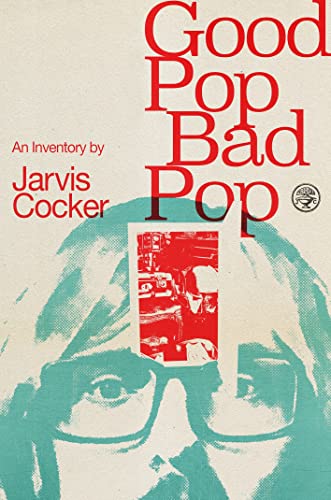
Jarvis Cocker is a hoarder. His attic is full of a lifetime of tat - some of it of great historical significance in tracing the origins of his pop career, much of it merely the detritus of memory. Broken spectacles, Imperial Leather soap bars worn down to their labels, carrier bags, ring pulls, charity shop ties. For each one, Jarvis wants to decide whether to "keep or cob" (chuck out). But each one is part of his life, his story.
Good Pop, Bad Pop is described as "an inventory" but it's really a unique autobiography... albeit one that only goes as far as the moment he falls out of a window while trying to impress a girl and ends up in hospital for weeks. Although his band, Pulp, had been in existence for years by this point, it's only while convalescing that he really finds his muse. Everything up till that point has merely been about finding the right ingredients for his masterplan, which he encapsulates with the equation "Scott (Walker) + Barry (White) + Eurodisco + Gritty Northern Realism = The Future". This isn't a book that deals with that future... I guess we'll have to wait for volume 2. It's not a book that deals in great detail with his songs either - Leonard Cohen advises him against that. Although it's easy to make links. No, it's a book that's full of the wit and wisdom of one of our greatest everyman entertainers... the fact that he repeatedly wonders how much he can get for some of this tat on eBay says it all. Fame hasn't changed Jarvis Cocker. He's still one of us. And if you love his songs, you'll love this book.
Here's one of my favourite early Pulp songs which springs to life in Good Pop, Bad Pop...
In a effort to start getting this blog back on track, I thought I'd mention that I finally finished Amy Rigby's excellent autobiography, Girl To City, a few weeks back. I haven't had the necessary time or mental energy for reading over the past few months, so this took me ages to get through, but I had a good session with it while on holiday and finished it at last.
It was also the case that I was enjoying Amy's writing so much that I didn't want the book to end. Telling her story from being a young girl discovering records, through her New York student years, to becoming a parent and finally getting a solo record deal, the book is unflinchingly honest, self-deprecating and very funny. There's a string of doomed relationships, bands that sparkle briefly then fizzle out quickly, and a sense that the only reason it took Amy so long to achieve her dream was a lack of confidence in her own abilities... something I could relate to a lot.
She also paints a vivid picture of New York in the late 70s and early 80s, a time when the city when seemed on the verge of falling apart and sinking into the mire. It's a time and place I find endlessly fascinating, and this book really places you there, among the dilapidated squats and grubby underground nightclubs that seem a world away from how we picture the Big Apple today.
You do find out about the true story of the plaster cow too...
Mark 'E' Everett is only 9 years older than me, so not especially an old man... but grumpy, he's been doing an excellent job at for years. He's got plenty of good reasons for that, as revealed in his autobiography 'Things The Grandchildren Should Know', which I wrote about almost ten years ago on a blog long since shut down. I still have the keys though, so here's my review of that book from ten years past...
Things The Grandchildren Should Know is the most honest and touching and human rockstar autobiography I've ever read. But then I didn't really expect anything else from Mark 'E' Everett of the Eels (curiously, after many years avoiding the definite article when naming this band, I find Everett himself has no such qualms), a songwriter who's made a career out of refusing to compromise or play the record company game.
Beyond his maverick career, Everett's life is fascinating for a number of reasons. As chronicled in a recent BBC documentary, his father, Hugh Everett III, was the scientist who developed the many worlds theory of quantum physics... he's basically the chap who came up with parallel realities. Unfortunately, Everett Senior's theories were largely discounted in his own lifetime and have only been taken seriously in the years since his death.
Then there's the tragedy. E's life is full of it. From finding his father dead and seeing a plane crash in the street outside his house... to his sister's suicide on the verge of the Eels first world tour... to his mother's subsequent death from cancer... to the death of his cousin and her husband, flight attendants on one of the planes that hit the Pentagon on 9/11.
Despite all this, the tone of Things The Grandchildren... is resolutely positive. Yes, E shares with us the darkest moments of his life, and the bitterness and anger he feels over the way he's often been mistreated by the music industry machine, but this doesn't ever come across as whiney or self-pitying. He's completely aware that despite all the negative moments in his life, he's also been lucky enough to make a living doing something he loves - writing and performing music.
There's a recurring theme to the Eels' music that I've mentioned before on this blog. It's about finding the positive in even life's darkest moments, and it crops up again and again in songs like 'Mr. E's Beautiful Blues', 'Hey Man, Now You're Really Living' and 'Rotten World Blues'. After reading Mark Oliver Everett's story, I think it's fair to say this sentiment - like everything else in E's art - comes straight from the heart.
I reckon all this makes E the sweetest Grumpy Old Man you could ever hope to meet, and that's perfectly encapsulated in this song, the "theme tune" to his life story...
2. Eels - Things The Grandchildren Should Know
I'm turning out just like my father
Though I swore I never would
Now I can say that I have love for him
I never really understood
What it must have been like for him
Living inside his head
I feel like he's here with me now
Even though he's dead
Eels have a new album out this week which I'm enjoying very much and I'll no doubt write about in more detail soon. Here's the single in case you haven't heard it.
(*"Local" as in "from our neck of the blogosphere".)
After reading the aforementioned Morrissey Autobiography, for a little light relief over the Christmas period, I splashed out on a copy of Drawn To The Deep End by Martin - yes, that Martin - Pond. I've got to say it cheered me up no end...
Martin will no doubt think I mean that sarcastically, but it really did, despite (or maybe because of) the rather downbeat subject matter. DTTDE is a novel Martin serialised while he was writing it on one of his old blogs a few years back , getting feedback as he went along. I remember reading parts of it there and always looked forward to seeing the finished novel. Well, it turned out Martin had stealth-published it a few months ago via Amazon, both digitally and in paper. And because I'm old-fashioned and always prefer to read books on paper (if god had wanted us to read books on kindles, he'd have made tree trunks out of microchips), I jumped at the chance to hold an actual copy in my hands for the ten minutes of reading I manage each night before nodding into unconsciousness.
Except... it actually turned out that Martin's book was so good I didn't nod off at all, and raced through it faster than I've read a book in ages. (Ah, how I remember those days when I used to read a book a week. Before I got a life.)
Drawn To The Deep End is an intense character study of Peter, a man driven to the verge of depression by the death of his girlfriend, trying desperately to claw his way out, grasping at any straw (often straw women) that bends his way. It's a book that has a lot to say about being a lonely 30-something man in this day and age... and as someone who was just that ten or so years ago (and maybe only my age has changed, in some ways), I related to it very much. It's also very funny - shot through with dark observational humour that makes you wince and nod and wish you'd written it yourself. You may end up screaming at Peter. He does make some very unwise decisions. But you'll understand why, every step of the way. What is "happiness", anyway?
Anyway, go read it. Find out more at Martin's other website, here.
Oh, yes, and obviously it goes without saying this book is named after one of the best albums of the 90s. Here's a truly great track from that...
My favourite writer has inspired, and been inspired by, all kinds of interesting songs... here's a few that share a title with the greatest hits of Stephen King's back catalogue.
By the way, I already did a Top 10 Misery Songs back on the old blog. Search that one out for Kathy Bates and her sledgehammer.
Stephen King stole the title of The Shining from Lennon's Instant Karma ("We all shine on...") James stole the title from King, as did Badly Drawn Boy. All work and no play makes Jack a dull boy.
The first King novel I read, back when I was only 14, and the one that got me hooked. This track was written for the less-than-great movie adaptation by a past-their-prime Ramones. Still. You take what you can get.
Despite his love of music, this is one of the few King novels to steal its title wholesale from a rock 'n' roll song. But if you're gonna steal, you might as well steal from Saint Bob. Everyone else does.
The first, but I'm sorry to say, probably not the last time Sir Cliff will find his way onto this blog. I have a shameless soft spot for his mid-70s output... though I'm sure he'd be horrified at the suggestion that his song might have any connection to King's pig-blood drenched heroine.
Backstage at the V96 Festival, a mate of mine pulled Keith from The Prodigy round on a child's ride-on tractor.
Firestarter isn't one of King's best novels, but the movie adaptation was better than some. Good cast, at least, including Drew Barrymore, David Keith, Martin Sheen, George C. Scott and Heather Locklear (who was contractually obliged to appear because it was 1984).
The movie of the same name was adapted from King's novella 'The Body', so he didn't steal the title of Ben E. King's classic soul heartwrencher himself. But it was a perfect fit.
1. The Alarm - The Stand
Directly inspired by King's magnum opus.
Oh I have been out searching With the black book in my hand And I've looked between the lines that lie on the pages that I tread I met the walking dude, religious, in his worn down cowboy boots And he walked liked no man on earth I swear he had no name I swear he had no name
Got a favourite song with the same title as a Stephen King book? Celine Dion's Tommyknockers, perhaps? Share it with the class...
A person should not believe in an -ism, he should believe in himself. I quote John Lennon, "I don't believe in Beatles, I just believe in me." Good point there. After all, he was the walrus. I could be the walrus. I'd still have to bum rides off people.
Long before the tantrums and tiaras, the dirge for Diana, the ridiculous megastar pomposity... it's easy to forget that once upon a time, Elton John & Bernie Taupin wrote songs as beautiful as this one.
Not Mad Bob's only visit to Wonderland. He's no doubt got a season ticket.
1. Jefferson Airplane - White Rabbit
One pill makes you larger And one pill makes you small And the ones that mother gives you Don't do anything at all Go ask Alice - when she's 10 feet tall
So those are the tunes that Carroll my Lewis... but which song sends you down the rabbit hole?
I was planning a Top Ten Alice In Wonderland Songs, but there were so many good tracks, I had to split them into two lists. Today then, Songs With Alice In The Title (not all of them the Wonderland girl, but most of them touched by her in one way or another). Next post... Wonderland (and its inhabitants).
Alice in the playground She ain’t got a boyfriend Oh oh that’s a pity She’s not even pretty Alice hears them whisper They smile when they see her Oh, oh she’ll discover Girls don’t hurt each other
Of course, Alice Cooper has made far better records, both as a band and as a solo artist. But this is the only one I could find with Alice in the title, so check it out. It's the mellow side of Coops... surprisingly sweet.
After many years as a solo artist, Ben has reformed the Ben Folds Five (all three of them) for a tour later this year. Not sure I can afford tickets, but it'd be great to see the band back together playing songs like this again.
Keighley's finest. Not that there's a whole lot of competition for that title.
1. Tom Waits - Alice
Written with Kathleen Brennan, Waits' dreamy song is dedicated to Alice Liddell, the girl who inspired Lewis Carroll to write Alice's Adventures in Wonderland.
Back soon with my 'In Wonderland' Top Ten... meanwhile, which song with Alice in the title sends you to Wonderland?