I had wondered whether there was any merit / desire to
continue the Cancel Culture Club into 2026. We had such a good run towards the
end of last year, maybe we should have quit while we were ahead.
I decided to test the water and see if there was any
willingness to continue. And despite (or perhaps because of) the rather
sensitive subject matter of today’s songs, the committee rose to the occasion. Let’s
hear what they all think of this "classic" 1962 single from Phil Spector’s Wall
Of Sound…
We’ll start with JC, the Vinyl Villain, purely because he
was the first to send me a reply. And to be honest, until he did, I figured we
were all prepared to let this feature fade into the mists of the blogosphere…
The Phil Spector ‘wall of sound’ era was the early-mid 60s,
and so my initial knowledge of the songs that had been huge hits came solely
from hearing them, as a young kid, on BBC Radio shows at least a decade or so
later.The songs were constantly played
in ‘Golden Hour’ segments and suchlike, and with the radio being a near
constant presence in my home, I can, more or less, still recite the likes of
‘Be My Baby’, ‘Da Doo Ron Ron’ and ‘River Deep, Mountain High’ as they are
ingrained in my memory.
But I can’t do similar with ‘He Hit Me (It Felt Like A
Kiss)’.Indeed, I had to go to You Tube
to familiarise myself with it, and I genuinely didn’t recognise it.I’m not saying, for certain, that this was
the very first time I will have heard it, but it wasn’t a tune I recognised.
This, in my mind anyway, kind of says that the song was
cancelled long before that sort of phrase had ever been thought of.Having now heard the lyric, and looked it up
online to make sure I had heard it properly, let’s keep it that way.It’s abhorrent.
It turns out that JC is right - the song was pretty
much cancelled back in the day… something I hadn’t realised myself as it still
crops up on Crystals and Spector compilations pretty frequently. Allmusic
tells us…
While radio play was initially encouraging, the complaints
quickly began pouring in and, with the general public itself apparently
preparing to rise up in protest against the record, igniting one of those
periodic feeding frenzies to which society is so oddly prone, Spector pulled
the single, ironically just as it prepared to enter the chart. Controversy can
encourage sales, after all, as well as cripple them.
We’ll return to JC later, but for now let’s jump
over to Khayem from Dubhed, who’s ready
to separate the song from the sentiment… to start with, at least.
Structurally and sonically, it’s a brilliant song, the
minimal (at least, for Phil Spector) layers of sound perfectly complementing a
frankly perfect vocal delivery.
Neither songwriters Gerry Goffin and Carole King nor Spector
have, as far as I’m aware, sought to present the song as anything other than
what it was, the narrator rationalising that being hit by her boyfriend is a
sign of his love. The song was inspired by a real-life exchange Goffin &
King had with a teenage “Little” Eva (pre-Locomotion, she was their
babysitter), when she shared that she was regularly beaten by her boyfriend,
but had normalised the experience.
The song makes no attempt at a value judgement or counter,
the narrator simply presents their perspective as a statement of fact. I don’t
know that Goffin & King were intentionally trying to subvert the pop form,
but there is a power in what is left out as much as what is explicit in the
lyrics.
“If he didn’t care for me I could never have made him mad But he hit me And I was glad”
The image those lines create is of an otherwise emotionally
bereft, controlling relationship where physical harm is seen as a validation, a
hint of attention, a ‘gift’ of love.
And it’s clear that the chilling final line of “And when he
kissed me / He made me his” isn’t about how we might make ourselves vulnerable
and give ourselves wholly when feeling in love, but of objectification, of
being owned, possessed.
At least, that’s how it looks in the 21st century. I get it,
that I was already an adult when I first heard this song properly, with a
(slightly) greater understanding of what is now recognised and reviled as
abusive behaviour.
Would the target audience of 1962 have read between the
lines? Possibly not, given that it seemed socially acceptable - amusing, even -
to hit women until relatively recently. That scene in 1980 film Airplane!
springs to mind, with passengers queueing behind Leslie Neilson’s doctor to
‘slap sense’ into a distraught female passenger. And this is a comedy.
I had asked myself exactly the same question, K, so I was rather
surprised to discover (above) that most of the audience back in 1962 clearly could
read between the lines and didn’t like what they heard. It’s always tempting to
wonder if the generations that preceded us were ignorant savages. It’s the
arrogance of youth, but I should be growing out of that now I’m in my 50s.
Maybe we never learn.
Yet, I’m sure that the song resonated with many, who read
that deeper, darker meaning into the lyrics at the time. Despite Spector’s
‘neutral’ production - and acknowledging the subsequent revelation of his
monstrous abuse of woman - this is no jaunty sing-a-long. The funereal bass
line throughout and Barbara Alston’s vocals are not the norm. I hear the latter
now as being flat and disembodied, the life and expression seemingly
dissipated, the words of ‘justification’ seemingly learned by rote. That said,
it’s perhaps no surprise that the band disliked the song and Alston later
disowned it.
Interestingly, Carole King would also disown the song later
in her life – but perhaps that change of heart only game after she herself fell
victim to domestic violence (not from Goffin, but from her third husband, Rick
Evers, who died in 1978).
I have a couple of cover versions of He Hit Me (And It Felt
Like A Kiss) in my collection. One is by Grizzly Bear, which effectively
translates to a same-sex relationship. The other is by Catherine Anne Davies, aka The Anchoress, who has openly shared her lived experience of an abusive
relationship. I recalled that they both sounded like pretty straight covers but
I was intrigued to revisit them and see if either artists had adapted the
lyrics in any way. As it happens, they haven’t.
All of which protracted preamble (and thanks for sticking
with me) leads me to conclude that I don’t think this song should be cancelled.
I don’t think the writers or performers, then and now, have intended to present
a narrative or message that an abusive relationship is okay. They’re simply
conveyed the perception of someone in that situation and left it to the
listener to arrive at their own understanding and interpretation of the
narrative.
I think you nailed that, K – over on allmusic again, critic
Dave Thompson suggested that both the songwriters and Spector were more
interested in “documenting” domestic violence rather than “preaching”. Again,
it’s tempting to wonder if a pop song aimed primarily at teenagers is the right
place to do that… but in asking that question, am I making a similar value
judgement on young people that I aimed at older generations earlier? Can’t
teenagers be just as socially aware as adults – even more so in some cases? I
dunno… I think back to myself as a teenager. I certainly thought I knew it all,
and knew better than my elders in a lot of cases… but a lot of my opinions back
then wouldn’t stand up to any kind of scrutiny today.
Let’s move on to C from Sundried Sparrows,
who also feels initially torn between the medium and the message…
Sadly, no matter how much I like this song aurally for its
kitsch, characteristically Spector, production - the strings, the drumbeat, the
vocals so of their time, etc. - I just can't listen to it now without thinking
about the many women I've heard about, and the few whom I've also known, who've
been physically abused by their partners.The song delivers its heartrending message with haunting sincerity.At no point does it seem satirical or
exaggerated.He hit me.And I was glad.
It absolutely nails the particularly toxic psychological
element of an abusive relationship. The very idea that the boyfriend's violent
reaction to the girl's unfaithfulness is proof of his "love", and
that she's grateful for this, grateful that he showed how much he
"cares", reveals so much. She's grateful to be loved by someone
capable of hitting her, as if the circumstances - where she confessed to being
unfaithful - made it perfectly acceptable for him to do so. We all know that,
in reality, it wouldn't end there. It would only be the beginning.The balance of power has already been tested
and proven in his favour, the cycle of abuse would continue.
I’m reminded of Lucy Mangan’s review of a new Netflix
documentary that I read recently in the Grauniad.
I’ll quote a whole paragraph for context…
Lover, Liar, Predator tells the stories of several women who
were coerced, abused and raped by a man called Aaron Swan over his decades-long
career. He was 17 when he approached Natalie at a party. She was 17 too but, as
a devout Christian with a very protected upbringing, effectively younger and
highly vulnerable to his charms. He put pressure on her to give up her
virginity. She got pregnant and they married. He was “demeaning and unkind” to
her, insulting her looks, claiming to be in love with his ex and subjecting her
to violent, unwanted sex (“I endured whatever was required … I thought that’s
what sex was”) for years.
Mangan calls the documentary “an instant rebuttal to that
most unsympathetic question: why don’t women just leave their abuser?”, and the
explanation given at the end of the paragraph above is both horrifying and
deeply, deeply sad. It’s heartbreaking that anyone can grow to accept this
behaviour as a norm. And in the current climate, where so many rich, powerful
men are attempting to justify the mistreatment of women, to excuse it, to
normalise it (or to just pretend it didn’t happen)… I guess we have to keep
reminding ourselves how that power balance works. Maybe that’s a reason not to
cancel this song, as unpleasant as it clearly is. And maybe that’s why artists
like the ones Khayem cites above feel the need to revisit it 60+ years later.
It's very telling too, I think, that our narrator uses the
phrase, "but it didn't hurt me".It's really subtle but something about the use of the words
"it" and "me" in this line give it a different slant. To me
this says nothing about actual physical pain, instead it appears to refer to
the overall outcome - i.e. she's come out of it ok.She now has proof of his love, no harm done.Being hit and being kissed are now
metaphorically the same to her, declarations of adoration.
Which takes us right back to that chilling quote from the
Lucy Mangan article, doesn’t it?
Also very telling, as sadly so many women in abusive
relationships will attest to, is the description of the boyfriend's tenderness
immediately afterwards.It's so
desperately, horribly true that typical behaviour of an abuser is to bombard
their partner with affection, tenderness and remorse as well - lovebombing -
enough to manipulate the abused into complete forgiveness and denial of the
bright scarlet flags being waved in their faces.And then we get the possession thing:
"and when he kissed me, he made me his".Of course, all my modern feminist tendencies
are aggrieved by this one small possessive word - and I know it was very
different in past decades, I must cut it some slack!But still, given what has gone on before in
this simple, disturbing description of a relationship, that final line carries
a graver message.
Yeah, I don’t think that line would be so exceptional in
another pop song – there’s a distinction surely to be made between possession
in terms of ownership and possession in terms of symbiotic devotion? It’s human
nature to want to be so close to another person as to feel like you belong to
them. I thought about all the songs that use this particular phrase...
What do you notice about those lists? The songs claiming
ownership all come from men. The ones pledging to be (or denying that they are)
a possession all come from women.
Admittedly, I’ve rigged the vote, there were some songs that
broke the gender barriers established in my samples above (in fact, after about
1990, far more women appear to be claiming a man to be “mine” than the other
way round). Maybe relationship equality really has taken hold in the pop world?
Sorry, C – I keep interrupting you!
I only read about the history of this song after I'd put
down my own thoughts - the background (as has probably already been mentioned)
being that Goffin & King wrote it after their babysitter, Little Eva, told
them that she put up with her boyfriend beating her because it was motivated by
his love. I also read that there were widespread protests about it on its
initial release, so it's not as if we're just coming at it from a more modern
perspective.Should it be cancelled now,
though- or are we able to hear it as a
brutal but cautionary tale?Unfortunately, whilst I can hear it as the latter, I just think it's too
close for comfort for airplay in an age where domestic abuse is still so
prevalent. And knowing it was based on truth and presented without any irony
just puts the tin lid on it now.
Ah yes – the irony interpretation. It would be possible to
present the lyrics of this song in an ironic fashion – arguably, that may well
be what the cover versions Khayem alerted us to earlier are attempting to do.
But to quote Dave
Thomson one more time…
In more ironic hands (and a more understanding age), 'He Hit
Me' might have passed at least as satire. But Spector showed no sign of
appreciating that, nor did he feel any need to.
Which might be a good time to let Alyson of the Jukebox Time Machine have her say.
What’s It All About, Alyson?
This response won’t take long Rol, because any song that is
titled, He Hit Me (It Felt Like a Kiss) is a big no-no from me. Having looked
into it a bit more, it seems this was a line used prior to the song being
written as it appeared in films, most famously in the musical Carousel. The
songwriters Gerry Goffin and Carol King apparently heard their babysitter
(Little Eva of Locomotion fame) use it and Gerry (the lyricist) thought it
would be a good subject matter for a song – WRONG. It seems that people who
suffer domestic abuse or endure dysfunctional relationships can see it as a
sign that their partner really loves them, because of the passion aroused in
them at the thought of losing them!! I know what I would think if anyone ever
hit me, and it wouldn’t be that they felt so passionately about me they were
driven to violence. But I suppose I have been lucky in that regard, and not all
women are as lucky. The fact Amy Winehouse also recorded it reflected her
troubled relationship with “her Blake”.
I couldn’t find a version by Amy anywhere, Alyson, although
I did find this
clip where she discusses the song. Then again, I also saw it suggested
online that Amy had wanted to do a cover of Lesley Gore’s You Don’t Own Me… but
she settled on recording another Gore song instead.
It’s getting harder and harder to sift facts from fan- or
AI-created nonsense these days though. Anyway, you were saying…
So, for the first time in this series, I am going for
absolute cancellation. It doesn’t even have any redeeming features in terms of
how it sounds – a dirge that matches the grim subject matter being explored.
Ironic too that the song’s producer was Phil Spector who had a dire track
record when it came to relationships with women.
Yes, I’m surprised other committee members haven’t made more
of the fact that Phil Spector was the man behind this particular misfire. Perhaps
Martin from New Amusements
will have something to say about that…
The Crystals. Where to begin? I mean, the lyrics are
desperate - first of all, our narrator tries to make light of her boyfriend's
casual violence ("he hit me but it didn't hurt me"), then find a
positive in it ("he hit me and I knew he loved me"), then celebrate
it ("he hit me and I knew I loved him"). In the middle of all that,
she even seems to welcome the abuse ("he hit me and I was glad"). All
of which made me wonder if this warped perspective came from producer Phil
Spector but no, it's a Goffin-King composition, and based on the real-life
experience of their babysitter, Little Eva. So a cautionary tale, perhaps? And,
as such, there may be no cultural grounds for cancellation. That said, this is
far from the best work of everyone involved, so if I never heard it again I
wouldn't be too upset. You might even say I was glad.
Which seems to be the overall sentiment regarding this
particular tune. Thank you, Martin. But wait… when I threw this suggestion out
to the committee, I also name-dropped a couple of other tunes which (on the
surface, at least) tackle a similar subject matter. Mainly because I figured
they might pop up as part of the discussion… although I’m wondering now if they
might not have done, and the only reason people felt drawn to comment on them
was because I’d made the link.
The first was this, which has quite a similar title…
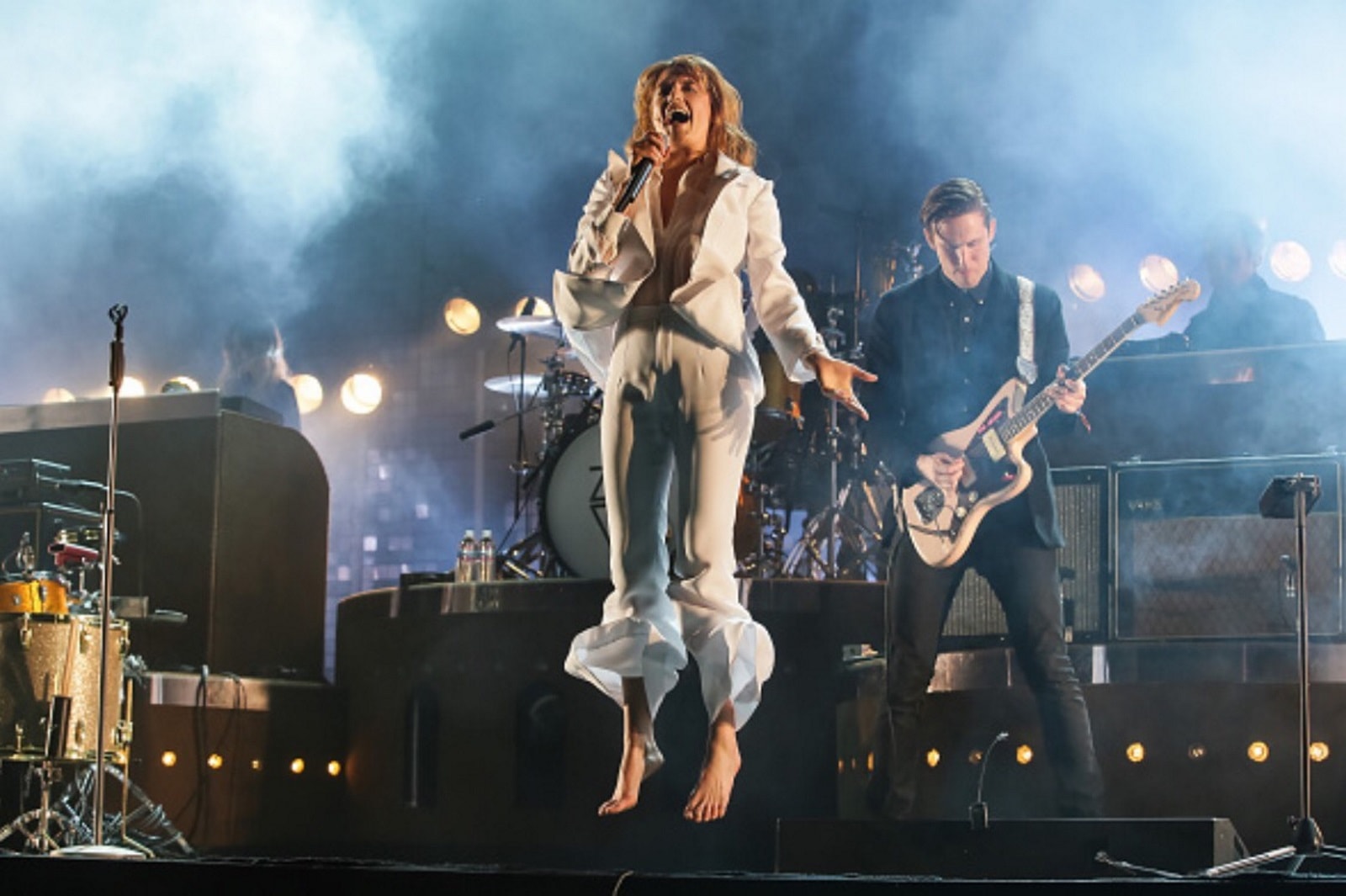
Should we be equally disturbed by the way Florence links
love to violence?
Let’s return to Martin…
The Florence & The Machine track, at first glance, is
less concerning. Both halves of the couple seem to be giving as good as they
get: "You hit me once, I hit you back, you gave a kick, I gave a slap, you
smashed a plate over my head, then I set fire to our bed" and so on. I
mean, it's not a relationship I'd want to be in but if it works for them...
except "a kiss with a fist is better than none". That doesn't seem
like a healthy position for anyone to be in. That said, I have seen the
argument that this song isn't about symbiotic domestic abuse but rather a
metaphor for the strength of the narrator and her lover’s passion. Mind you, in
the same paragraph I saw a parallel drawn with Bleeding Love by Leona Lewis,
which possibly undermines the argument.
Bottom line? I wouldn't cancel either of them. I find The
Crystals song more problematic, because of the excusing, acceptance and
desperate celebration of the narrator's position. It feels less like she is an
equal partner in a relationship, more like she has Stockholm syndrome. But it
serves as a cautionary tale, perhaps, and gets people (not least the Cancel
Culture Club jury) talking about these issues. And it's the same for Florence;
I'm not sure I'd want anyone to be joyfully singing along with this, but if
they're thinking about the position someone must be in to feel that a kiss with
a fist is better than none, then the song has done some good work. Possibly.
Which brings us nicely back to the question about art being
unafraid to tackle serious, disturbing issues and make us question our thoughts
on such matters. But does that depend on the ability and maturity of the
audience to appreciate those questions… should casual, throwaway “pop” art be
given the same consideration in that respect as serious literature or fine art?
Is it patronising to draw a line between the two… or necessary, in order to
avoid misinterpretation and offence?
What did JC make of Kiss With A Fist?
Until posed the question by Rol, I hadn’t imagined linking
this to the song by The Crystals.
It’s not one I’d call to be cancelled, primarily as I don’t
think it is concerning itself with domestic violence per se.
Yup, it beings with ‘you hit me once, I hit you back, you
gave me a kick, I gave you a slap, you smashed a plate over my head’ which is
all very horrific sounding.But the next
line, delivered without any sort of pause - ‘then I set fire to our bed’ – is
the key to everything as it confirms the lyrics are very much about imagery.
The use of poetic license makes for a sound defence.
Burning beds are a common metaphor in pop songs, aren’t
they? For all kinds of things…
It’s all put into context by the next verse ‘My black eye
casts no shadow, your red eye sees no blame, your slaps don't stick, your kicks
don't hit, so we remain the same, love sticks, sweat drips, break the lock if
it don’t fit.’
I think of it more as a cartoon love song that could be
accompanied by scenes from ‘Tom and Jerry’ or ‘Itchy and Scratchy’.
Quite – and funnily enough, C made exactly the same
comparison…
Talking of irony, you also mentioned: Florence & The
Machine:Kiss With A Fist.
And I hear this very differently to the Crystals' song.It's over-the-top, it has proper shock value,
it's crazily extreme (I hope!) and it's this which somehow diminishes any
seriousness.It depicts its violence in
a kind of 'Tom & Jerry' way - yes, I can visualise the animation for it
now, the plate smashed to smithereens over the head of someone causing a whirl
of dizzy stars as they fall to the ground with crossed eyes, the bed engulfed
in a cartoon fire, flecks of soot and sparks flying everywhere....It's vicious, visceral...in fact, too
vicious, too visceral, to be truly troubling. Isn't that weird? - perhaps it
should be very troubling, but its unrestrained ferocity, is the key - like a
parody.And it's two-way.Not that I'm condoning two-way violence over
one-way violence but, you know, fair's fair here.I'm fine with this!
Some couples like a bit of rough, eh? And as long as
everyone is consenting… well, it’s a free world, as Kirsty once said.
Although they have the same theme, their intentions are to
be evaluated differently. While Florence & The Machine apparently
addresses a violent relationship that is lived by both partners, The Crystals
sing about domestic violence. Kiss With a Fist is a great and catchy pop song
with an abstruse theme that I can't quite understand, but still tolerate. In He
Hit Me, the partner's violence in the relationship is glorified and celebrated
as proof of love. These ideas counteract pretty much everything women have
fought for in recent decades and should no longer be played, as there is still
too much domestic violence in our society.
Thank you, Walter – a fine summation of the overall feelings
of the committee thus far. Although there’s still one member waiting to have
his say – Swiss Adam from Bagging
Area. And I’ve saved Adam to the end for a good reason. He was the only one
brave enough to tackle the other song that I couldn’t help think about in
regard to this particular subject…
(I tried to find the actual video and the only site that had it in full wanted me to age-verify before they'd let me watch it!)
Before we get onto that little beauty, let’s hear Adam’s
thoughts on today’s principal defendant…
He Hit Me (And It Felt Like A Kiss) is a problematic song
and I don't know where I stand on it.
Domestic violence is very bad.
The song is clearly about domestic violence.
It was co- written by Carole King (under Phil Spector's
guidance).
Spector was a very bad person- imprisoned for murdering a
woman and abusive to his wife Ronnie over many years.
It was written by Goffin and King on discovering that their
babysitter- Little Eva, yes, that Little Eva- was regularly beaten up by her
boyfriend and when they asked her why she put up with it, she replied it was
because he loved her so much.
The song's musical backing is wonderfully Spectorian but
also brooding and dark. The Crystals sing so sweetly but sound numbed.
Are the writers, singers and musicians merely documenting
domestic violence? Is there a glorification of it? Does it normalise domestic
violence?
Maybe. Maybe. Probably.
Carole King later said she regretted ever writing the song
and was a survivor of domestic abuse herself.
It's bad news all round.
Maybe it's best if it's seen as a time specific 1960s/ Phil
Spector piece- and treated in the same way that we treat 'art' from the racist
1930s USA or 1940s Germany, something that existed, can be discussed
historically/sociologically but not held up for enjoyment or admiration.
We keep circling back to these overriding questions about
art, its intention, our ability to consider it in context… and the question of
whether everyone will / can do so in the same way. And do we have the right to
censor art – to CANCEL it – just because other people might not be able to
apply the same context and considerations that we do?
Is there even a kind of pseudo-intellectual arrogance in
asking that question? Oh, the dilemma!
Sorry. Carry on, Adam…
Without it though, we'd never have had Spiritualized's She
Kissed Me (And It felt Like A Hit) which is a brilliant inversion of the title
and the song, Jason comparing love and narcotics in a way only he can.
Well, that is clearly a work of genius on all counts. But
what about the elephant in the room, Adam?
The Prodigy's Smack My Bitch Up is also problematic. It was
at the time. I always got a sense that The Prodigy knew it would be, that a
deliberate wind up of left-wing sensibilities was behind it, that it was in
some way 'punk'. Weird in a way because rave (which they came out of) was not
misogynistic, it was very much desexualised in some ways, boys (with long hair)
and girls (with short hair) in baggy clothes dancing to music in a field.
Smack My Bitch Up was a nod to hip hop (which had massive
use of the word bitch all the place) and a shock factor song with an equally
'hey Mum I shocked the kids' video. Even at the time it felt like we should
have moved past that, it was puerile rather than punk.
I always felt that it was a case of arrogant folly. Of
trying too hard to be ‘punk’, crossing the same line that John Lydon did many
years earlier… but because times had moved on, the Prodigy had to try so much
harder to be shocking in the 90s than Johnny Rotten did in the 70s. I’d be
interested to know if the song was written after the success of Breathe and
Firestarter – if, following the triumph of those two discs, the band felt
untouchable… but also felt they had to push the envelope much, much further to maintain
their status. Positioning it as the opening track on Fat of the Land seems an
intentionally button-pushing act of self-belief / over-confidence.
The Beastie Boys weighed in and asked Prodigy not to play it
at the Reading Festival (both were appearing on the same bill) and the Prodigy
obviously said no. Rightly I guess - one artist can’t choose another's setlist.
The Beastie Boys themselves had gone through their own awakening regarding
gender equality and sexism, denouncing their own early sexist singles and their
attitudes and apologising on Sure Shot -
'I want to say a little something that's long overdue
The disrespect to women has got to be through
To all the mothers and the sisters and the wives and friends
I want to offer my love and respect to the end'
The word Bitch has gone around. In the 80s and 90s it became
seen as misogynistic (rightly), a term used by men to demean women. I can't be
the only one who remembers left wing activists chanting 'ditch the bitch' when
protesting against Thatcher. I loathed Thatcher but that ain't right.
In the 90s the word seemed to be used mainly by men who
wanted to appear edgy. Hello Quentin Tarantino (a man so edgy he liberally used
the N- word too, writing scripts full of both words as if it was a personal
mission to see how often he could get actors to say them - one of the most
quoted lines from Reservoir Dogs is, 'Eddie, you keep talking like a bitch, I'm
gonna slap you like a bitch'. He goes similarly off in Pulp Fiction 'why you
trying to fuck him like a bitch?'). Tarantino looked at the world like a 13
year old boy. I think Smack My Bitch Up looks at it the same way.
Interestingly my daughter, a history/ politics graduate,
left wing feminist who wrote a dissertation on 4th wave feminism and beauty
culture, uses the word bitch a lot - in a fairly non- genderised way, sometimes
describing both men and women as 'bitches'- the exact meaning varies, it can be
used to describe those who gossip and talk shit about people but also to
describe people, male or female, who are sneaky, duplicitous or those don't
stand up for themselves. She also uses it in a 'boss bitch' way, celebrating
powerful women (the reclaiming the word thing, using it as a sign of strength
and empowerment). Maybe we're post-bitch now.
I wonder if the current usage of the word comes from the
world of Drag Race and its ilk? Whenever I hear it used in that context,
that’s what I think of. Or maybe Meredith Brooks just changed the world back in 1997 (same year as the Prodigy!)…
Shake It Out - The Dog Days Are Over, the answer days are here! Thanks for playing Saturday Snapshots again this week... well done, Lynchie for another well-deserved victory. We might have to start giving him a handicap!
Kissing is a popular subject for songwriters... perhaps because most people dream of becoming pop stars as a way of getting some. But here are ten songs you probably wouldn't want to lock lips with...
OK, first confession. For many years - in fact, until very recently - I thought Will Powers was a man. Knowing only this song, I thought the male voice was Will and the female was an uncredited backing singer. Turns out Will is really the creation of celebrity portrait photographer Lynn Goldsmith and his voice is actually hers slowed down.
You probably knew that already.
Anyway, Kissing With Confidence comes from Will's 1983 album Dancing For Mental Health which was a spoof of self-help shysters and the way they preyed on vulnerable people's insecurities. It was written by Goldsmith, with a little help from Nile Rodgers, Steve Winwood, Todd Rundgren and Carly Simon's songwriting partner Jacob Brackman. Nice to have celebrity pals.
Anyway, in the song Lynn starts out as a particularly bad kisser...
I'd giggle like I had no brains Or else I'd start to cough I thought my perspiration stains Would turn a fellow off
...but this is soon fixed by Will's self-help advice and she soon becomes a kissaholic.
I put an end to worrying, I learned the way from Will And showed me kissing with confidence was an acquired skill When my boyfriends get too hot I can cool 'em down Now I'm kissing with confidence everywhere in town.
Some would consider this the worst kind of redneck anthem: provincial deep south BS, the sort of thing that gives country music a bad rep around the rest of the world. I defend my interest by suggesting Blake might be being a little tongue-in-cheek here... although the video would suggest otherwise. I think it's a case of giving the baser part of his fanbase exactly what they believe they want. And it's fun if you can put yourself in their heads. I'm not sure if Brad Paisley's Southern Comfort Zone was a direct response to this song, but it could well have been.
Fuzzy guitared dream pop (they call it "lovewave") from a California indie band who toured a few years back with The Jesus & Mary Chain. One listen to this and you can tell they were supporting their heroes.
Not a cover of John Barry's theme to Thunderball, but a typically Gedgian tale of infidelity and its consequences by David... and his... erm... ex-girlfriend.
I was 16 when this came out, and I probably should have been too cool for George by then, but I was a frustrated romantic and this smoky, low key ballad hit all the right notes. A few months later, I remember playing it in my dad's car on the night I borrowed it to take a girl out on a date for the first time. That night was typical of what I laughably refer to now as my teenage love life, and yet... time makes fond memories of almost everything.
And no, there was no kissing on that date. But yes, if there had been, this song would have been apt. (There was no second date either. She was just trying to make her ex jealous.)
This was another strong contender for My Top Ten Bickering Couples Songs a few weeks back. A few months ago I got my ears around a very cheap 50 track compilation of Tennessee Ernie songs; up until that point I only really knew him for Sixteen Tons, but this collection was an eye-opener. Lots of interesting songs with funny little stories to tell, of which this is one of my favourites. It features a couple arguing about how they can put up with most of their partner's flaws, but when the kisses go cool, that's a bridge too far...
Helen:Don't mind that smelly pipe that's always stickin' in your face! Ernie:
Don't mind your shoes and stockin's always scattered 'round the place! Helen:I'll put up with the cigarettes you put out on the floor! Both:
But your cool cool kisses I just won't take no more!
Bear in mind, however, this is from 1950, so it's a sign of the times when Helen sings (in a humorous vein)...
Don't mind the way you beat me every time we have a fight...
Perhaps it says something about me that my favourite song by Ms. Welch is her punky debut single (originally recorded by her previous band Ashok, under the title 'Happy Slap'). A lot of people think it's a song about domestic violence, but Florence claims that's not the case, that the violence is metaphorical, and it's more about the mental turmoil some couples put themselves through in extremely passionate relationships.
Or something.
Kiss With A Fist is the shortest song Florence has ever released, and it's a lot more fun that much of the wispy, floaty, pseudo-Kate Bush stuff she's released since (although I do like quite a lot of that too). But I guess there's more of an audience for that sort of stuff than 2 minute guitar blasts these days.
One of my favourites from Jenny Lewis, it begins with her fending off the advances of a lecherous cobbler and ends with her dropping acid and getting unlucky in love. Probably not your best bet for a safe smooch.
To be lonely is a habit like smoking or taking drugs And I've quit them both, but, man, was it rough...
1. Richard Thompson - Cold Kisses
Thompson plays a particular unpleasant character in this one, going through his girlfriend's belongings for evidence of her ex-boyfriends... trying to find out if any of those cold kisses might ever get warm again. A classic example of Thompson's bravura songwriting, it ends with him hearing his girlfriend's key in the lock, only for him to quickly tidy up so that she can find him sitting reading a paperback when she comes in, oblivious to his jealous snooping.
Here I am behind enemy lines Looking for secrets, looking for signs Old boyfriends, big and small Got to see how I measure up to them all
This one's handsome, not too bright This one's clever with his hands alright Tougher than me if it came to a fight
And this one's a poet, a bit of a wet Bit of a gypsy, a bit of a threat I wonder if she's got over him yet?
Perhaps I should have played this one in my dad's car on that hopeless first date...
Jessie's like a hurricane... but Craig might not be the one to save her from herself.
I know you're gonna say what I know you're gonna say
I know you'll look at the ground, I know you'll probably cry
You're a beautiful girl and you're a pretty good waitress
But Jessie, I don't think I'm the guy
Gaslight Anthem mainman Brian Fallon's side-project, this was the Horrible Crowes' debut single, and it may well be the best thing they've done. From an album called Elsie, so extra points for that.
Here comes the story of the Hurricane The man the authorities came to blame For something that he never done Put in a prison cell but one time he could-a been The champion of the world.
At 8 minutes 36 in length, Bob beats our Number One today by just 13 seconds. It's a wonderfully noirish, novelistic piece of storytelling... yet not quite strong enough to knock this one off the top spot...
1. Neil Young & Crazy Horse - Like A Hurricane
The trick of making an epic 8 minute plus rock song is to make it still seem too short.
As I said above, if you're looking for White Rabbits, click the Alice In Wonderland link. Here's a white hare instead. Don't give me any grief about hares not being rabbits.
Yes, the kookiness is starting to grate and she's yet to record anything else quite as exciting as Kiss With A Fist... but when I read that "551 people disliked this video beacuse (sic) they saw her waring (sic) earring (sic) that looks (sic) like "illuminati" sign", I was impressed. Particularly that the youtube commenter knew how to spell Illuminati.
Stephin Merritt at his most playful, from the mighty 69 (Love Songs).
1. Jenny Lewis & The Watson Twins - Rabbit Fur Coat
Just fantastic storytelling...
I was of poor folk
But my mother had a rabbit fur coat
And a girl of less character pushed her down the L.A. River
Hand over that rabbit fur coat
She put a knife to her throat
Hand over that rabbit fur coat
When my ma refused, the girl kicked dirt on her blouse
Stay away from my mansion house