King Cnut could not hold back the tide, and I cannot hold back society's full-throttle descent into dystopia. All I can do is watch helplessly from the sidelines, and nod my head sagely when others hold a mirror up to the madness.
I was reading an interview with the directors Anthony and Joseph Russo, the men responsible for some of the most successful Marvel movies in recent years, including the last two Avengers movies. They were asked why they thought Marvel had taken a bit of a kicking at the box office recently, was it so-called "super-hero fatigue"? Apparently not. Instead, the Russo Brothers put it down to what they call a "generational divide".
There’s a big generational divide about how you consume
media. There’s a generation that’s used to appointment viewing and going to a
theatre on a certain date to see something, but it’s ageing out. Meanwhile the
new generation are ‘I want it now, I want to process it now’, then moving onto
the next thing, which they process whilst doing two other things at the same
time.
I think it's a reflection of the current state of everything. It's difficult right now, it's an interesting time. I think we're in a transitional period and people don't know quite yet how they're going to receive stories moving forward, or what kinds of stories they're going to want.
When I read this, I wanted to cry. (You'll have noticed: I want to cry a lot these days.) But Mr. Russo wasn't quite done...
We have never collectively, globally, processed our
conversation so intimately and quickly as we do now. I think that creates
problems, where we over-process and don't care about context anymore. We
communicate through memes and headlines, with nobody reading past two
sentences, so everything's 100 characters or less – or 10-second videos on
social media you swipe through. I think that the two-hour format, the structure
that goes into making a movie, it’s over a century old now and everything
always transitions. So, there is something happening again and that form is
repetitive. But it's hard to reinvent that form and I think this next
generation is looking for ways to tell their own stories that service their own
sort of collective ADHD.
It almost sounds to me like he's given up. Like he's saying, "I'm an old guy," (well, he's a year older than me) "I'm ready to accept that youngsters are doing things differently these days and the only stories we'll have in the future will be 10 second video chunks or 100-letter tweets. Stick a fork in me, I'm done."
Thankfully, not everyone appears so ready to be put out to pasture. About the only sensible idea I've heard in the run up to Election Day is the proposal that the next government are considering banning smartphones for all under 16s. Of course, it won't happen... and it'd be impossible to police even if it did. And maybe it's too late to shut the barn door, that horse has already bolted. But still... old man shakes his fist at the sky.
It was rather a wet Half Term, so Sam and I went to the cinema twice. The first film, John Krasinski's If, I would recommend to anyone. It's one of the best kids films I've seen in a long time, up there with the inestimable Paddington 2 as a fun family movie with real heart. And I say that as someone with a very low tolerance for schmaltz.
And then we saw Garfield, which was a bag of shite.
I like Garfield. But this movie was only a Garfield film for the first 20 minutes, then it became a Chris Pratt / Samuel L. Jackson buddy movie... only not even as interesting as that might sound. Garfield was there on the screen, but there was very little Garfield. If that makes sense.
Anyway, about halfway through the movie, I noticed a mum a few rows in front of us with two young daughters. I'd seen them arrive (late) and then watched the mum leave the girls to go fetch popcorn. The older girl (who I reckon was still a few years younger than Sam) was clearly even less enamoured with the movie than I was. So Mum gave her a mobile phone and she sat watching Tiktok videos, hypnotised, her instant-gratification-dopamine-fix sated till the credits rolled.
King Cnut could not hold back the tide, and I cannot hold back society's full-throttle descent into dystopia. All I can do is watch helplessly from the sidelines, and nod my head sagely when others hold a mirror up to the madness.
I would like to personally THANK YOU for being one of my readers.
Nothing makes me happier than seeing close friends and family enjoy a better life. I hope reading this blog helped make your life better this year :)
If you and/or your loved ones had a wonderful experience with this blog, I'd love to hear about it!
Would you please help me by leaving a review for this blog?
Your Feedback Means The World To Me.
Thanks again for choosing His Top Ten!
I would like to remind you that writing a review of your experience will help me improve my customer satisfaction.
All reviews (whether good, bad, or otherwise) will be posted on Trustblog.com to help other people make more informed decisions about their blogging consumption.
There's an episode of Black Mirror called Nosedive, in which Bryce Dallas Howard plays a young woman living in a society where every aspect of your life is rated by everyone you meet. People are encouraged to rate every interaction they have during the course of their day out of 5 stars, and everyone carries around their own aggregate score which is visible to anyone they meet via special eye filters. People go out of their way to be extra nice and keep their star rating high... because once those ratings start to dip, it becomes harder and harder to function in society.
It's all a typical Charlie Brooker satire of our need for approval and the dopamine hits that come with smileys, thumbs up and blog comments (as we've been talking about recently in Self-Help For Cynics). And like all the best satires, it feels like it's only one step away from reality.
Except... the one area where Black Mirror diverts from reality is that the people in that episode are only expected to provide a star rating. More and more these days, I'm being asked to write actual reviews every time I make a purchase or use a service... and as much as I like writing, I take umbrage at the idea of providing free marketing copy. Maybe it's because I used to work in advertising, where I got paid to write that kind of stuff. But also, I get little enough time to write... why would I waste it this way?
Clearly there are many people who like to do this. It started with eBay feedback and Amazon reviews, then came Tripadvisor and Trustpilot... and now everyone expects written feedback for everything. The blurb at the top of the page is an edited version of one of many emails I've received over the last couple of months from a company I bought a T-shirt from. It was a very nice T-shirt, but I paid you a fair amount for it and had no complaints about the service... surely that's enough? I'm not writing your marketing on top of that! STOP EMAILING ME EVERY FIVE MINUTES LIKE SOME BABY REINDEER STALKER OR A NEEDY EX!
Look. I posted a picture of the T-shirt on my blog. Please. Leave me alone now.
King Cnut could not hold back the tide, and I cannot hold back society's full-throttle descent into dystopia. All I can do is watch helplessly from the sidelines, and nod my head sagely when others hold a mirror up to the madness.
We live on top of a moor looking down on the picturesque Yorkshire town jumped-up village of Holmfirth. By the way, before I begin today's rant, I discovered my first Holmfirth song earlier this week...
I do like folk music, but that's probably a bit too folky even for me. And it makes the town village sound even more yokely than Last of the Summer Wine managed, which is going some. We are way more cosmopolitan than the Watersons give us credit for. The police were called to investigate a couple of weekends back because some Huddersfield gangster fired a gun outside one of the local hostile-ries. They shut the road for over 24 hours while forensic teams combed the area for a bullet. I'm not sure they found it, but they probably found lots of dog shit. Clearly we're less sedate than Chatteris...
Car crime's low, gun crime's lower, The town hall band CD, it's a grower, You never hear of folk getting knocked on the bonce, Although there was a drive by shouting once.
Who knew there could be so many songs relating to this particular kind of social irritant?
Do I need to add much more? We live up on top of a moor, and though the road that passes our house is just a link connecting two main roads, the boy racers still love to floor their pedals as they pass us by. I'll never understand this, or why your car needs more than one exhaust pipe, or why you prefer a car that rumbles like a jackhammer. If my car made that kind of noise, I'd be taking it to the garage.
Anyway, the purpose of this post isn't just to whinge about boy racers. It's to highlight another excellent song by Wolves of Glendale. Be warned, I will probably find any excuse to feature this band over the next few months. Those of you who feel that comedy and popular music should never mix, feel free to look away now. The rest of you... well, all I can add is that Louise generally has very little time for much of the music I feature on this blog, but she loves this. Then again, she hates boy racers even more than I do. Here's a tip - don't switch it off until it's well past the 90 second mark...
King Cnut could not hold back the tide, and I cannot hold back society's full-throttle descent into dystopia. All I can do is watch helplessly from the sidelines, and nod my head sagely when others hold a mirror up to the madness.
Thinkin' all about those censored sequences
Worryin' about the consequences
Waiting until I come to my senses
Better put it all in present tenses
Little triggers that you pull with your tongue
Little triggers, I don't want to be hung up, strung up
Louise was very excited to hear that they had remastered / re-issued the original Tomb Raider games and that she would be able to play them on Sam's Nintendo. But not before she first had to contend with the Trigger Warning...
You'll find various people online debating / objecting to / agreeing with / traumatised by the insertion of this trigger warning into Lara Croft's original adventures. As someone who's not part of any of the minorities besmirched by their representation in said game, it's probably not my place to comment... so let's look to English Literature instead for our trigger warnings...
This production includes depictions of self-harm, graphic violence and references to suicide.
That's from a theatre production of King Lear, in case you were wondering.
Meanwhile, The Globe Theatre recently warned its audiences about a new production of Romeo & Juliet...
This production contains depictions of suicide, moments of violence, and references to drug use. It contains gunshot sound effects and the use of stage blood.
If you have been affected by any of the issues raised in this production of Romeo and Juliet please find details below of organisations offering advice and support.
A bunch of Tory politicians were soon up in arms about that, while world famous thespian Christopher Biggins chipped in, "It’s wokeness gone mad!"
Ralph Fiennes, Ian McKellen and Matt Smith have also taken umbrage at the trigger warnings many theatres have begun to inflict upon their audiences, though Ralph's response was a little more considered than Biggins...
"I think the impact of theatre should be that you’re shocked and you should be disturbed. I don’t think you should be prepared for these things and when I was young, (we) never had trigger warnings for shows.”
I find myself torn on this matter... and not just because if I do voice outrage at trigger warnings, I'll be joining the protest line alongside Tory MPs, Christopher Biggins and The Daily Mail. Just the very fact that those guys are in opposition makes me want to clutch trigger warnings to my bosom and welcome them with an open heart.
I teach English to young people who are suffering severe mental health problems... and yet they have to study the same texts as every other GCSE student in the country, including Macbeth (full of violence, murder, suicide and a gradual descent into madness for more than one character) and An Inspector Calls (a murder mystery which hinges around a character being driven to commit suicide by drinking bleach after she's been raped - arguably by more than one man - and castigated by society). Many of these issues are central to the experiences of some of the young people I teach... and yet, they do appear to be able to draw a line between the fiction they're studying and the reality they may have endured. Perhaps that's not always the case, and we treat every student on an individual basis depending on whether the medical professionals think they're ready to tackle such issues... but from everything I've been reading about mental health, hiding away from unpleasant issues only makes them worse. I'm not a psychiatrist and it's not my job to offer counselling... just to teach the texts. Still, it does make me wonder if trigger warnings might be doing more harm than good, shielding people from things they'd be better off confronting... if they ever want to come to terms with them.
Of course, there's a difference between trigger warnings for disturbing subject matter and trigger warnings for outdated attitudes. I don't have a problem reading Huckleberry Finn or To Kill A Mockingbird with a class, both of which contain frequent use of racial epithets that were common parlance at the time they were written. It's a good way of opening up a debate about language, racism and historic prejudice. It's even more important to teach these texts nowadays, and have those discussions, than ever before. If the publishers want to add a warning that the texts contain outdated attitudes "rooted in racial and ethnic prejudices", that's fine with me. Far better that than banning or editing said texts and pretending prejudice just didn't exist. Doesn't exist.
Having thought about it then, I completely agree with that trigger warning on Tomb Raider, as ridiculous and trivial as it might seem at first glance. Because when it comes to any kind of outdated attitude, I do believe it's important to "acknowledge its harmful impact and learn from it". And really, does that one screen affect your enjoyment of the game in any way? If it does, that probably says more about your own deep-rooted prejudices than it does about Tomb Raider.
To close on a lighter note, I did have to laugh when watching Die Hard again this Christmas past, noting that despite the gratuitous violence and liberal use of foul language (though interestingly, for an 80s film, no really outdated attitudes), the biggest warning to pop up on screen before hand was that by watching this film, we'd be subjected to the image of Bruce Willis smoking a cigarette! Different times indeed...
Warning: this blog contains many, many outdated attitudes. Usually involving popular music of the 80s that the cool kids have long since decided is rubbish... but I still love it anyway. That's my trigger warning, in case its needed.
History is made, not repeated And you hide behind words that make you feel needed And what you read in those books made you so conceited So in order for love to be true My dreams will have to Become my only rules
I want a warning I want a warning I want something more than a warning
Wake me up on into a world outdated And the older you get the more you seem jaded As you search for the quotes to make it seem complicated So in order for love to be true Even my nightmares Become my only rules
I want a warning I want a warning I want something more than a warning
"Your blog's changed over the past 12 months. It used to be more personal, more honest... a lot of woe-is-me whinging, yeah, but it felt like it was being written by an actual human being with hopes and fears, aspirations and... feelings. Lately though, it's just a bunch of lists linking to some cool tunes with feeble jokes and forced bonhomie."
Ironically, the latter is what I set out to create when I started My Top Ten (maybe with less feeble jokes and more genuine bonhomie). My old blog, Sunset Over Slawit, was very personal and open and honest... and I'd grown tired of sharing that side of myself with the world, so I devised MTT as purely a music list blog, because I thought that's all I wanted to write. Look back at the first couple of years of posts here, and that's all it is. Gradually though, the personal side took control again until MTT had basically become what SOS was 12 years ago... with arguably better tunes.
So why have I gone full circle? If I'm being brutally honest, the answer is depression. There. I said it. Here's a track from the excellent Cherry Red compilation Revolt Into Style 1979 which sums it up better than any amount of my piffle can...
"You're depressed? Join the fucking club, mate. If it's that bad, why don't you do something about it?"
What do you suggest? I went to the doctor about anxiety a couple of years back and all they did was put me on cognitive behavioural therapy. Via an app. I'm too cynical for CBT, you need a certain proclivity for tree-hugging, I believe... and on app? I understand that the NHS is at breaking point... I work in the NHS now!... so I know why I'm on an app rather than speaking to a real person... especially considering some of the people I work with who are on a waiting list for face-to-face CBT and have a much greater need than I ever will. There comes a point where you have to put your own "illness" into perspective and realise that it's mild enough to not bother the NHS with. Besides, if CBT is out... what am I left with?
So what's getting me so down? Well, beyond bereavement and the ongoing mid-life crisis, The World itself is top of the list. I've posted a few excerpts from Dave Eggers' novel The Every recently, all of which paint a depressing picture of a world where technology has robbed us of freedom, individuality, creativity and joy. And then last week, this happened...
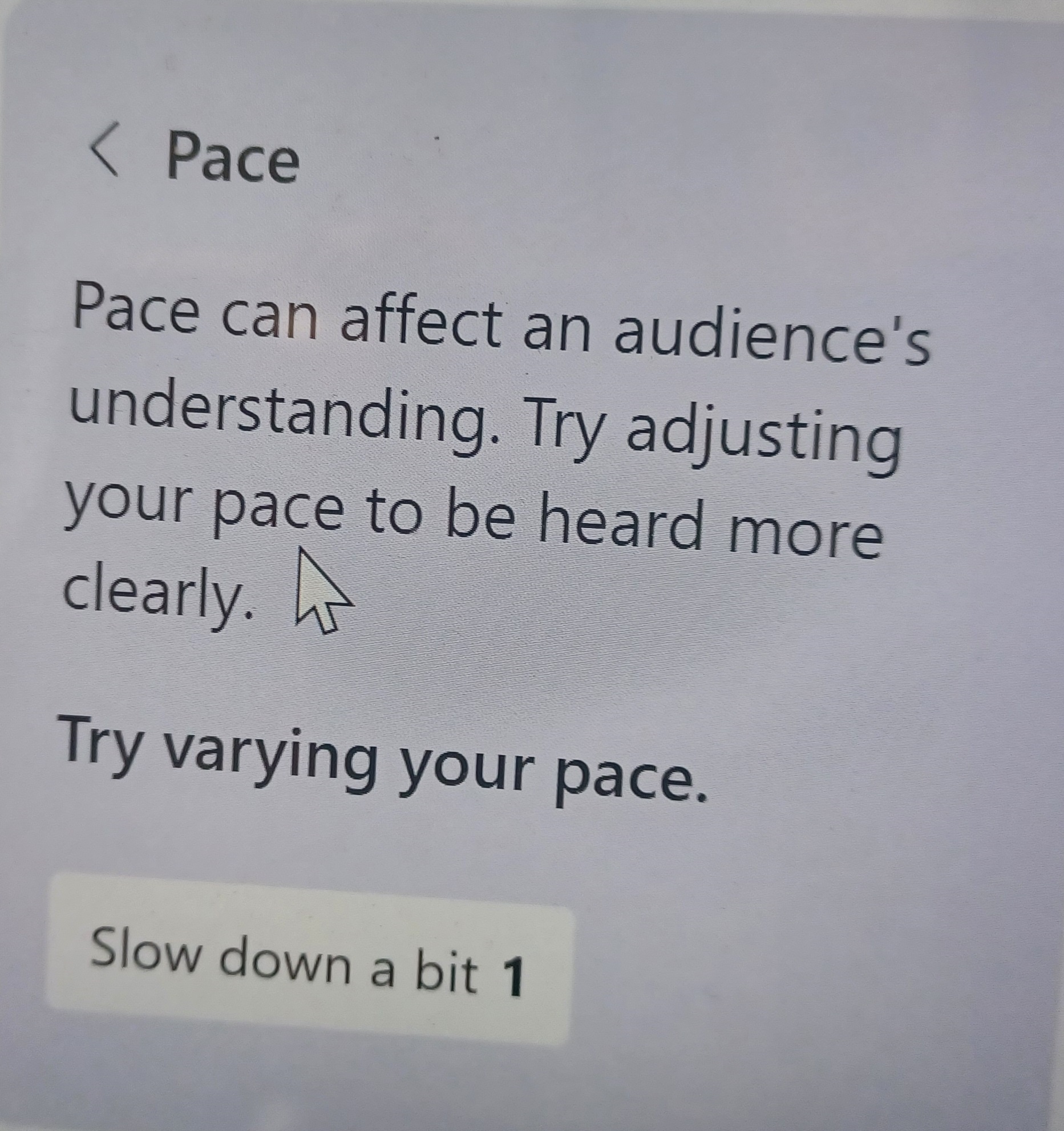
I've been teaching some lessons over the internet via Microsoft Teams again lately. Only the odd one, not like in Lockdown when all my lessons were online, but following my most recent lesson, I received a report from my "Speaker Coach". It seems that my lesson had been monitored by artificial intelligence, and the AI had a few tips for how I could improve my performance...
It's not all criticism though. Our robot gods have judged me worthy in certain ways...
I'm sorry, but this really is the End Times as far as I'm concerned. This comes in the same week as I heard about schoolkids using AI to do their homework, while a number of pioneers in the field warn that the end is nigh. In a rage, I shared my concerns with Ben...
Rol: End times.
Ben: Not really, just a reorientation of the labour process.
The spinning jenny, the combustion engine, even the printing press saw large modifications to labour.
This is now a quantification of the individual
Terrifying in it's direction, yes. But... "End times"? Only when the revolution comes, comrade!
I have a problem when technology interferes with art. Making a speech is on a similar level to art or music or writing. The fact that we now have AI attempting (and dictating how we should do) these things based on shitty algorithms... either human beings are really no longer needed, or we're just becoming so fucking lazy that our relevance is at an end. There's a distinction between replacing a boring and laborious mechanical process... and replacing creativity.
That's part of the restructuring of the labour process. Creativity was distinctly only an option for the ruling class until the 20th century and this will see to it going back to that
The de-skilling of labour through technology is something inherent to the capitalist mode of production, and it has found a way to penetrate the arts
And that really is the end times.
(You see now why I don't let Ben come round here as much as I used to? He's even more depressing than I am!)
We've reached a tipping point, and there's no going back from this. We've already got AI art generators, AI story and poetry generators, we've even got AI writing songs and recording new tunes from long defunct bands. I used to tell myself that when I retired, I would start writing stories again... but really, what's the point? By then, the computers will be doing all that for us. It'll be terrible, but we'll have lost the critical faculties that enable us to tell the difference.
When I started writing blogs in 2006, the medium still felt relatively fresh and innovative. Blogs are old hat nowadays though, and most people who still write them are the wrong side of 40. But with an increasing amount of AI-generated content on the internet (and everywhere else), the weeds will soon choke out the flowers.
And you wonder why I'm depressed... at least I can still rely on good, old-fashioned music to cheer me up.
7ebra are two sisters from Sweden, following in the steps of First Aid Kit, but with more of an Wet Leg vibe. As far as I can tell, they wrote all their own songs, play their own instruments, and use their own voices to sing with. In other words, no AI was used in the production of this wonderful tune...
Last one of these, I promise. Or else (much as I'm trying to help promote his book), I'm probably going to get sued by Dave Eggers.
King Cnut could not hold back the tide, and I cannot hold back society's full-throttle descent into dystopia. All I can do is watch helplessly from the sidelines, and nod my head sagely when others hold a mirror up to the madness. Which is why I've been using this space over the past few weeks to quote excerpts from Dave Eggers' novel, The Every. Because everyone should read it and face up to the horror...
In this final extract,
Delaney goes to work in the Iris-Tracking department. When she arrives, they
give her a demonstration of the tech they’re developing…
“As you sit in front of the monitor,” Eric said, “an
infrared light is being directed toward your pupils. This causes reflections in
your pupil and your cornea. The vector between the cornea and the pupil is
tracked by the infrared camera, and this way we can determine what you’re
looking at. This also gives us the ability to track when you get fixated on
something, what order you look at things – that kind of hierarchy is so crucial
to study – and what things you come back to.”
“So it’s recording what I look at and how long,” Delaney
said.
“Exactly!”
“But isn’t this illegal? I mean, didn’t some people sue?”
“They did,” Eric said, “and there are laws in some cities
and states that limit their use. But there are millions of systems already in
place. It’s been used for years within the Implicit Association Test, the Stroop
Test, and of course the gaze contingency paradigms.”
“Using eye-trackers,” he continued, “just to figure out what
people are looking at and for how long – that’s only logical. It started with
marketing. Advertisers want to know what you look at. This serves the makers of
ads, sure, but it serves the audience, too. A bad ad will be ignored, whoever
made it will find a new line of work, and you won’t see any more like it.”
“It’s the perfect symbiosis,” Delaney said, and finally she
saw Eric smile. “It’s the only meaningful way to determine what someone’s
actually seeing, reading and responding to.”
“Well, right,” he said, and Delaney felt he’d finally begun
to like her again. “The utility of this tech for advertisers drove its progress
in the first place. But then film and TV asked for data, and that was huge. It
was kind of hilarious, because with the first test group we did, we discovered
that this one very highly paid actress was actually being avoided by most eyes.
She would come onscreen and the eyes – seventy-seven per cent of them – would
dart away like she was an infection. You can be sure that data affected her
future salary negotiations.”
Delaney smiled, then thought she should be more emphatic in
her approval of his joke. “Ha!” she said.
“So apply the same idea to any movie or show. Where does the
eye really gravitate to?” Explosions, breasts, abs – this was obvious enough.
But it gets more subtle. Certain clothing tested high, certain cities, décor,
facial expressions, animals, children. If you knew what I knew, you’d know how
seriously it’s already affected filmmaking. By any chance have you noticed a
pretty dramatic increase in the number of toddlers and medium-sized dogs in
contemporary film?”
“I have!” Delaney lied.
Eric nodded. “And fewer heavy people. Fewer romantic scenes
between people over 65. Fewer scenes in Baltimore and the Middle East. That’s
the easy stuff, to be honest.”
Soon enough, Eye
Tracking Technology takes off in a big way…
The global debate about the ethics of eye tracking, which
began that afternoon, was vigorous, but anyone hoping to hold back the advent of
ETR was proven a fool. The unexamined glee with which it was embraced followed
a familiar pattern. First hobbyist explored its limits, producing results both
innocuous (which parent does your baby prefer?) and terrifying (which parent
does your teenager prefer?). Heedless capitalists leaped in, apps and related
products proliferating, enabling anyone with a self-cam to determine where the
eyes of any other humans around them were landing. The software and hardware
necessary had been built into Every phones for years; it was only a matter of
activating it.
Over the next few weeks, it became clear that because half
of humanity’s iris scans had already been stored, their owners could be singled
out in seconds. If a man ogled a woman at a New Jersey dog park, those eyes
could instantly be paired with the offender’s name, and his family, employers,
and the public would be duly notified of the transgression. A new wave of
suicides ensued, the embarrassment and discredit being too much for certain
called-out persons, mostly men. In the first week, one hundred and seven humans
in Tokyo took their lives, thirty-one of them by throwing themselves in front
of trains, the scene of their eyeshame. Tens of thousands followed elsewhere on
earth, and a few hundred, nicknamed Oedipals, chose a middle path – they gouged
out their eyes.
Whatever the name for the offenders, eyeshame was the term that stuck to the crime. The Every resisted
it, tried to push ocular offence, but
eyeshame was more direct and descriptive. It was not strictly speaking a crime,
of course; no laws prevented anyone from looking where they shouldn’t. But
shame ensued, and shame was deserved, and shame was the internet’s currency and
lever for change. As ETR spread without resistance among the vast majority of
the species, there were occasionally calls to ban it. But like most innovations
in the twenty-first century, the spread was caterwauling, without organisation
or caution, and thus unstoppable.
The latest changes to 6Music have me convinced they want me to switch off completely. It's been reported as another nail in the coffin of guitar music, and I can't say I disagree. Apparently The Bug Club are also up in arms about it. Who'll play songs like this on the radio anymore (other than Mickey and the wonderful Natasha)?
King Cnut could not hold back the tide, and I cannot hold back society's full-throttle descent into dystopia. All I can do is watch helplessly from the sidelines, and nod my head sagely when others hold a mirror up to the madness. Which is why I've been using this space over the past few weeks to quote excerpts from Dave Eggers' novel, The Every. Because everyone should read it and face up to the horror...
In this extract, the
Every introduces a new app which can measure the quality of friendship. Delaney
suggested it as a joke, but once it’s been developed, it quickly goes viral…
Delaney did not breathe. It was AuthentiFriend. Everything
was the same, but far more developed, and now it was called Friendy.
“Terrible name,” Joan said, “I hate it already.”
“No,” Preeti said. “It’s like a lie detector test. It tells
you if someone’s honest, candid. You know dogs can sense cancer? This senses
any untruth. Anything hidden, withheld. Is the word guile?”
“It can sense guile? That’s fucking dark,” Joan said.
“What’s the big number in the corner?” Helen asked. In the
upper right of the screen, above Urmila’s face, a number – 88 – was pulsing.
“That’s overall quality of friendship,” Preeti said. “You
know the stats about friendship. You live longer and healthier if you have quality
friendships. That’s why the slogan.” She pointed to the screen’s upper left
corner, where the words “Who are you real friends?” were written in a sharp and
accusatory font.
“It’s about quality, not quantity,” Preeti said. “We’re
always worried about the number of
friends we have, when we should be assessing the quality of those friendships.”
“This is sulphurous,” Joan said, and Delaney loved her for
it.
“It’s just for fun,” Preeti said.
“That is some diabolical fun,” Joan said.
Her opinion was in the minority. The others were trying to
decide on someone they should call – a test subject. Berit had a college friend
she thought would be appropriate. Minutes later, a dark-haired woman named
Anita appeared on the main screen. She was in Uppsala, Sweden.
“Hi, Anita!” Berit said. She had positioned herself across
the room, in a quiet corner. To Anita, Berit would appear to be alone, talking
to her on a tablet. But everyone else was watching Anita on the large screen.
“How are you?” Berit asked.
Anita’s answer, “Good!” was deemed untruthful.
“Are you sure?” Berit asked.
“Yes. Why?” Anita asked.
Friendy’s red lights were pulsing – lack of candour,
guardedness.
“I’ve always meant to ask you,” Berit said, “when we were in
college, you went to the Stockholm archipelago with a bunch of people.
Remember?”
“Of course,” Anita said. “Why?”
“My boyfriend at the time went with you,” Berit said.
“Remember Per?”
Delaney’s brain was on fire. A moment ago Berit had seemed
confident and kind, and now, with this weaselly tool, she’d become a weasel.
“I do,” Anita said uncertainly.
“You always seemed to have a thing for Per, am I right?”
Berit asked.
“I wouldn’t say it was a thing,”
Anita said. “Berit, why are you bringing this up now? It was eight years ago. I
haven’t seen Per since that summer.”
“I just always had a feeling something happened between you
two on that trip. And remember I couldn’t go. My brother was dying.”
“Yes, I know. I’ve always been sorry you couldn’t be with
us,” Anita said, her voice quavering and eyes growing wet. Friendy’s sensors
were going wild. “Nothing happened between us.”
A green light pulsed. This was truthful. The crowd was
impressed. Berit pressed on.
“Just tell me,” she said. “You were attracted to him, yes?”
“Oh Berit,” Anita said. “When are you coming home next?
Maybe we can talk then. I don’t like this.”
Overall Anita’s truthfulness score was in the low 20s.
“Never mind,” Berit said. “I got the answers I needed.”
And she ended the connection.
“This was a good friend of yours?” Preeti asked.
“Since we were six,” Berit said.
“Berit!” Joan snapped. ”Have you regressed to thirteen years
old? You can’t take this seriously. It’s a fucking app that some nerds here
developed.”
Berit laughed. “I know. I know it’s silly. I’ll call her
again some other time and get a read on things.”
Ro comforted her. “Give her a few more chances. Average them
together.” Her eyes were soft and magnanimous, almost saintly. “She deserves
that – an aggregate score.”
Nancy Sinatra and Lee Hazlewood recorded two albums together, in 1968 and 1972. They are essential listening. Less well known is their third collaboration, from 2004, just three years before Barton Lee's death. For some insane reason, this record was never released in the UK, and was only ever available on import from Australia. Utterly absurd, as it's a fantastic album that never fails to put a huge smile on my face...
King Cnut could not hold back the tide, and I cannot hold back society's full-throttle descent into dystopia. All I can do is watch helplessly from the sidelines, and nod my head sagely when others hold a mirror up to the madness. Which is why I've been using this space over the past few weeks to quote excerpts from Dave Eggers' novel, The Every. Because everyone should read it and face up to the horror...
In this extract, Delaney has to organise a Welcome2Me event in which she invites a
random selection of her colleagues (“Everyones”) to participate in a “get to
know you”-type social event. She chooses to take them to a local beach where a
colony of elephant seals have gathered to mate… but from the moment she
announces the event, she’s prepared for resistance.
Delaney wrote a three-paragraph description of the day’s
plan, including six links to basic and concise information about the seals,
their history on the Pacific coast, their mating cycles, Point Reyes in general
and Playa 36 specifically. “If you haven’t seen Pt. Reyes, be prepared,”
Delaney wrote. “It will be spectacular.” Not that anyone living in Northern
California needed to be told to bring layers, but she mentioned this, and she
mentioned sunscreen, and comfortable shoes, and a warm hat if one’s ears were
prone to chill. She sent a draft to Kiki, who, in a distracted moment, wrote only
“Food”. Delaney took this to mean that the Everyones could not be expected to
bring their own lunches, so Delaney arranged with a deli around the corner from
The Sea Shed to create eighty sandwiches for the day, for vegans and
vegetarians, pescatarians and carnivores, at least two options for every
attendee, and a bounty of side salads and drinks – all to be brought on the bus
in reusable containers.
A group of forty-two Everyones were selected by algorithm.
It was to be a cross-campus smorgasbord, a sampling rich in variety of
departments and interests. And because there would be photos and possibly group
photos, a representative and perhaps augmented display of the company’s
diversity was essential. Once the forty-two attendees had been chosen, a message
list was created, and Delaney’s now-three-page description of the event –
elucidating what would be available to drink and eat, and enumerating all that
need be brought – was sent to the forty-two on the Tuesday before the
excursion.
“No info here for the lactose-free…” said the first message,
and Delaney cursed herself for this easy oversight. “Ignore that event
description!” she wrote, “Better one to come!” She went through the entire
three pages again, editing an adding two pages more, this time anticipating
every allergy and preference. She covered gluten, eggs, nuts, nightshades and
cinnamon – recent but fast-spreading intolerances and de-preferences,
respectively – and this time, in a stroke of what she considered brilliance,
she mentioned the particular deli she’d engaged, Emil’s on Pacheco, in case
anyone wanted to pre-order and get the precise sandwich they wished.
“Emil’s? Have you seen this?” This message linked to a photo
of Emil, the young proprietor, posing with an Israeli flag, on what appeared to
be a Tel Aviv beach. This was followed by seventy-six messages from a fourth of
the forty-two Point Reyes attendees, most with links to bombastic articles and
messages about the rightness or wrongness of Israel vis a vis Palestine and
what any given Everyone would be saying by eating sandwiches made by a man (and
his staff) who were so proud of Israel and its misdeeds that he so
jingoistically would pose with its flag on a luxurious beach of oppression.
“Is the bus using plant-based fuel?” one attendee asked.
It’s a standard bus, so I assume so, Delaney wrote. “Do I need hiking boots?”
No, Delaney wrote, we’ll just be standing on sand, or in the parking lot near
the beach. “I don’t see a packing list. Usually there’s a packing list for such
an outdoor activity.” I provided a packing list, Delaney answered, though you
might have missed it because it’s embedded and short. You really only need
yourselves and, like I said, layers, and maybe a hat. I’m even bringing
sunscreen, so you can take that off the list! “What kind of sunscreen are you
bringing, Delaney?” Delaney had not actually bought the sunscreen yet, so she
looked online and found an organic brand, Sensible Dawn. This triggered an
avalanche. “Wait, now we’re supporting Scientology?” an Everyone wrote, and
Delaney soon found that Dawn Unger, the sunscreen’s founder, had been a
Scientologist, though she didn’t appear to be one now, and had posted no
content anywhere in support of Scientology. “Delaney, seeing elephant seals
shouldn’t involve cult-complicity,” one helpful Everyone wrote, in the most
measured of the messages. After four hours of screeds and ululations, totalling
413 messages covering the sins and virtues of every company that had or still
did provide sunscreen to the world, the group settled on an organic maker based
in the Antilles. That the product had travelled a few thousand miles seemed
likely to provoke a reaction of some kind, but at the end of Day Two, had not
yet done so.
The Welcome2Me event
inevitably proves disastrous, and soon after Delaney is invited to participate
in two restorative events in which the “survivors of the Playa 36 Debacle” are
invited to vent their emotions on the trauma they have endured.
The solutions to the beach, the bus, and the uncomfortable
proximity to wildlife were, again, direct and increasingly extreme. “Don’t
visit that beach,” was the first, and was followed by, “Close the beach,” then
“Don’t exploit animals for our gawking pleasure,” and finally it was agreed
that, “Humans should not be permitted near any animals in any context,” and
that, “Large groups of humans travelling together in fifteen-ton fuel-burning
vehicles are so obviously environmentally offensive and metaphorically obvious
that we cannot, ever, be part of the problem again.”
And that’s just the
beginning of the fall-out…
Speaking of the world going to hell in a handbasket, it's a sign of the times when Shakin' Stevens turns into a protest singer...
I bought this for Louise on Mother's Day. He crushed it with his own feet.
Someone at work asked, "Is Louise a big fan?" No. That's why it was funny.
Earlier in the week, Martin blogged about his experiments with ChatGPT, the new AI chatbot that's about to replace human "experts" across the world. We all agreed how scary this was. I commented that it reminded me of Dave Eggers' firm belief that society is moving towards handing over freedom of choice in return for the safety of conformity.
Here's another extract from The Every, a novel which is best described as 1984 meets Catch 22 with a healthy dollop of Gulliver's Travels. Yes, it's satire... but so close to reality that it's hard to work out which bits are true and which bits Eggers has created for comic effect.
In the following extract,
Delaney has gone to work for the HereMe department which creates Smart Speakers.
Eggers uses this as an excuse to chronicle the secret history of Smart
Speakers, which sounds like fiction… until you realise we’ve already lived
through much of it.
Smart speakers had an awkward introduction to the world.
They arrived in the 2010s to phenomenal sales, with hundreds of millions of
households adopting them within the first five years. Before The Every entered
the picture, the makers of the devices assured the buyers that the AI
assistants were never activated unless their designated name or code word was
spoken. This reassured the users that their private everyday conversations were
not being heard, that only brief requests were audible, and even then, never
stored. But a few months later, it was revealed that the smart speakers were in
fact listening all the time, or could
listen all the time. In fact, they could be activated by their manufacturers
any time at all. For this, the manufacturers apologised; perhaps there had been
some confusion, they said. Were we unclear?
The users, though momentarily upset at this foundational and
central deception, were assuaged when they were told that under no
circumstances were their conversations recorded.
It would be, both users and manufacturers agreed, an egregious breach of trust
to have a machine that a customer brought into their house – a machine,
everyone noted, that was purchased primarily to play music and inform them of
the current traffic – actually recording
the conversations conducted in these private households. That would be
unethical. And so it was assumed that no recording was being done by these home
assistants, until one day the manufacturers admitted that they had in fact been
recording just about every conversation every user had ever had, from the very
beginning.
Again the makers were contrite. When you were asking before
about whether we were recording conversations, they said, we didn’t quite
understand what you meant. We thought you meant recording and listening to these conversations, and
that of course we would never do. We would never.
We record the conversations of hundreds of millions of users, yes, but no
humans ever listen to any of these conversations. Conversations in the home,
between family members, are private, are sacrosanct! they said. We simply
record these conversations to improve our software, they said, to optimize our
services, to better serve you, the customers, better.
And for a while the users, though feeling wary and burned by
the series of revelations, looked askance at their smart speakers, wondering if
the tradeoff was actually worth it. On the one hand, their private family
conversations were being recorded and stored offsite for unknown future use by
a trillion-dollar company with a limitless litany of privacy violations. On the
other hand, they could find out the weather without ever looking out the
window.
Fine, the users said sternly, fists on hips, you can
continue to record everything we say, but – but! – if we ever find out that you
manufacturers were having actual humans
listen to our conversations, that will be one step over the line.
We would never! the manufacturers said, hurt by the
inference, which, they felt, was offensive even to think about, given how open
and transparent they had been from the start. Didn’t we reveal, they asked,
after we were caught, that our smart speakers were turning themselves off an on
at their own behest? And didn’t we admit, after we were caught, that we were
listening to and recording anything we wanted at any time, anything that was
said in the private homes of millions of users? And didn’t we reveal, after we
were caught, that we were recording all the private conversations every user
had in the privacy of their own homes?
After all this openness and contrition, they said, it stings
to think that customers would wonder aloud if the other shoes might drop. No
more shoes, said the manufacturers, would be dropping. We stand before you
barefoot and humbled.
When it was revealed that the manufacturers had in fact hired
10,000 humans, whose only purpose was to listen to, transcribe and analyse the
private conversations that had been recorded by these smart speakers, the
manufacturers were amazed at the outrage, as muted as it was. Yes, they said, we have all along been
recording and listening to your conversations, but none of these 10,000 workers
know your names, so what possible
difference would it make that we have all of your private conversations
recorded, and that we could with one or two keystrokes de-anonymize your
conversations at any time? And given the fact that every database ever created
has been hacked, these recordings could be accessed by anyone at any time who
had will enough to get them? What, the manufacturers asked, are you getting so
worked up about?
In fact, no one got worked up at all. Lawmakers were mute,
regulators invisible, and sales skyrocketed.
Eggers goes on to suggest the logical next steps for Smart Speakers... and they seem frighteningly prophetic. Go read The Every if you want to be really scared...
Miracle Legion came from Connecticut in 1983. They were on Rough Trade for a while, so the NME loved them. This is from their 1992 album Drenched. I'm a sucker for songs with "Ba ba ba ba baaa" choruses.
A few years back, I thought The Circle by Dave Eggers was the most frightening book I've ever read. The novel concerns a huge tech company (essentially Google crossed with Facebook) and its desire to control the world. Everything that happens in the novel is one step away from where we are today (actually, much of what Eggers predicted in The Circle has since come to pass), and that's what makes it so scary.
The Every is the sequel. Here, The Circle has swallowed up "The Jungle" (you can guess which company that might be) to become even more omnipotent, metamorphosing into The Every.
A young woman called Delaney goes to work at The Every with the intention of sabotaging the company from within. Her plan is to push The Every into increasing its control over our lives to the point that the public begin to object, rebel and fight back. It's hardly a spoiler to say that this isn't as easy as she thinks. Where The Circle was a novel about how big companies want to control us, The Every is more about how easily and willingly we cede control over our own lives to these big companies. The antagonist here is not a faceless corporation... it's us.
There's so much in this novel that hits home, and touches on the kind of issues that I've been writing about in Cnut Songs (like King Cnut, I want to hold back the tide... but realise I'm powerless to do so), so I've decided to run a few excerpts over the next few weeks. No further commentary is required from me: Eggers is able to express my fears and complaints about our dramatic plunge into dystopia far better than I ever could.
In this
extract, Delaney goes to work in a department called TellTale. The manager,
Alessandro, explains what the department does…
“People pick up a book,” he said, “and stop in the middle.
Why? With e-books we can study all of this in aggregate. We can take, for
example, two thousand readers of Jane Eyre and see who finished it. We actually
did that. Turns out 188 people did finish it. That’s not good, right? People
who read it all seem to like it. It’s at—” He tapped one of his screens a few
times and got the answer. “It’s a 83 per cent approval, which is high for a
dead author. So we dig deeper and see that of the 2000 people who started Jane
Eyre, most quitters put it down around page 177. So then we look at what
happens on page 177, and we see that people don’t seem to like this character
called Grace Poole. They find her scary and depressing. They want more of the
romance with Mr. Rochester. Now, if the author were alive, we could tell him—”
“Her,” Delaney corrected.
“Her?” Alessandro said reflexively, then went pale.
Oh no, Delaney thought. She’d seen this happen.
Alessandro stood up. He didn’t know what to do. He allowed
the vines of his hair to obscure his face completely, and seemed likely to
douse himself with gas and light a match.
“It’s OK,” Delaney said. “You meant Mr. Rochester.”
“I did?”
“I know you did. Like, if Mr. Rochester were alive, we could
tell him that his parts of the book were intriguing.”
“Okay. Right.” Alessandro began warming to the idea,
believing it his only way out of ruination. “That’s exactly what I meant. Where
were we?”
“You were saying you could fix Jane Eyre.”
“Well, we could,” he said, “but because the author is dead,
she”— he pressed the word so hard it erased centuries of chauvinism and
ignorance, “can’t learn from the data herself.”
“Sucks for her,” Delaney said, and saw Alessandro smile.
“But a living author, or a publisher, can avail themselves
of the numbers and act on them,” he said. “And this kind of data has been
invaluable to publishers and some of their authors already. Just those
data-points, sales versus book-starts versus completions, that’s huge.
Completions, of course, convert favourably to sales of the author’s next book.
So for publishers, figuring out where and why people are stopping is crucial.
Sometimes it’s obvious. Like unlikable characters. We can help fix that. We’ve
actually written a pretty simple code for turning an unlikable character into,
like, your favourite person.”
“Wow,” Delaney said.
“The main thing is that the main character should behave
they way you want them to, and do what you want them to do.”
“That’s just common sense,” said Delaney.
“Right? It kind of makes you worry about a lot of writers –
the fact that they didn’t know this. But we’re making inroads with colleges and
MFA programs, so now they have the information. We give it to them for free, as
a public service.”
Delaney made a grateful, admiring whistle-sound.
Alessandro moves on to
discuss screen-writing and the algorithms The Every has developed to “help”
screenwriters create more engaging movies (“For example, 82% of the best
scripts have the Catalysing Moment on page 11…") These formulas don’t just apply
to the creative side of movie making, but also to the critical side…
“Remember when assessments of the quality of a movie were an
unruly mess? Before critical aggregation, it was totally random. For a certain
movie, you had one critic saying one thing in Los Angeles, and another one in
Oslo saying something else, and there was no chance of order or consensus. But
when we applied percentages to each review, we could average them together, and it
became far more clear. A regular human in a fast-moving society doesn’t have
time to read twenty-five, or even three, reviews of a movie before they go see
it. But seeing it’s received an aggregated score of 74.61 percent – that’s
clarity.”
“And clarity is objectivity,” Delaney said.
He looked at her and grinned. “You belong here.”
“As you know,” he continued,” the aggregates worked so well
that they quickly moved from movies into painting, dance, sculpture, poetry. I
mean, you should have seen how low sonnets scored! That’s why you don’t see
those taught so much any more.”
“Sonnet? What’s a sonnet?” Delaney laughed.
Alessandro’s eyes were wild with mirth and inspiration.
“Then we brought numerical specificity to so-called fine art museums. In each
case there was some initial pushback, but the undeniable comfort of the numbers,
of simply knowing the quality of a work of art by its percentage, was soon
embraced by the overwhelming majority of people. Eighty-eight percent, to be
exact.”
“That’s the only reason we finally know who the best painter
was,” Delaney said. The Every had released their results a few years earlier,
the product of 32.1 million respondents. The greatest artist of all time was
Norman Rockwell, followed by Dale Chihuly, Frida Khalo, Pablo Picasso and
Patrick Nagel.
They shared a smile. “I liked when the Louvre started
showing the aggregates,” Delaney said.
“Right,” Alessandro said, “I mean, the Louvre came to us.
There were all these places doing bootleg aggregates and they wanted it done
right.”
“It was fascinating when The Last Supper was only a
sixty-six percent,” Delaney said.
“It had been so overrated for centuries! See, that kind of
thing was revelatory. We’re averaging together tens of thousands of ratings, as
opposed to taking the received wisdom of a few academics. The aggregates are
more democratic and egalitarian. Before the aggregates, it had all been so
hierarchical and subjective.”
“Subjectivity is just objectivity waiting for data,” Delaney
said.
“Right!” Alessandro said, and she saw him pause, again
working out whether any kind of compliment would be acceptable. He decided not
to risk it. “I mean, I think creatives are starting to acknowledge that we have
a valuable role to play. This high wall that was built between art and data had
to be torn down.”
The Klaxon 5 were a short-lived band on the London Pavilion record label in the mid-80s. They only released two singles, and that's a tragedy considering how good this one is... and it's about burning books too, which seems vaguely appropriate.
Cnut Songs is the occasional series where I find myself in the position of King Cnut, trying in vain to stop the tide of idiocy that keeps rolling over the sands of the modern world. Will I hold back that tide? Will I chuff. Still, here I go again...
This week I found myself in the uncomfortable, unusual and unenviable
position of disagreeing with Billy Bragg. This does not happen often. Over the
years, I’ve seen Billy speak on a wide range of issues, both live (at gigs, on
TV or radio) and in print, and have generally found myself in wholehearted
agreement with everything he says.
Last week though, Billy weighed in on the debate about editing
Roald Dahl’s books to remove words or thoughts which are now considered “offensive”. Including not referring to Augustus Gloop as fat and changing the Big Friendly Giant's coat so it's no longer black. Billy is in favour of some of these proposed edits, and put forward a semi-convincing
argument… but it’s one I can’t get along with.
I don’t believe we can change attitudes by blacklisting
words. I chose to use the word “blacklist” specifically, because it’s a
word some no longer feel should be used. Yes, there are many negative
connotations to the word “black”, but we won’t stamp out racial prejudice by banning
its use. I just typed “connotations of black” into google and here’s what came
up:
Woah. Are you going to edit those connotations out of every text
ever written?
Or… is it perhaps better to educate people that words can
have many multiple meanings in all kinds of different contexts, and just
because some (or many) of them might be negative, that shouldn't reflect or
interfere with more positive connotations of the same word. That's what I try to do as an English teacher anyway. (That said, this is the same idiocy that tells teachers they can't mark students' work using red pens any more, because red represents blood, danger and anger. AND NOTHING ELSE AT ALL.)
Of course, it’s very easy for me to write about misconceptions of the word black as a
middle-aged white male. So instead, let’s talk about a word I have a more first-hand experience of…
Fat.
When I was a kid, I struggled with my weight. (Still do, to
be honest, but nobody really gives a toss when you’re 50.) Maybe I wasn’t as fat
as Augustus Gloop, but I wasn’t as greedy either. (Roald Dahl chose an
unpleasant word to describe him because he’s an unpleasant character.) However,
I did get called names that referred to my less than elfin physique, especially
when Roland Browning, Grange Hill’s token fat kid, arrived on the scene.
Do I really believe that wouldn’t have happened if the kids
I went to school with had somehow been protected from ever seeing or hearing
the word fat in a negative context? Sorry, Billy… I just don’t buy it. You don’t
stop prejudice or ignorance or brutality through censorship. And certainly not
by censoring words! Because if you’re going to start removing all the potentially
insulting words or attitudes from fiction… where do you stop? Think about all
the murder and torture and abuse and horror that writers have been using in
stories since the beginning of time. Maybe if we edit all that stuff out, then people will
stop doing bad things to each other in the real world and we will truly achieve our utopia. On second thoughts, I think I might be onto something here. Let's start with The Bible, shall we?
(The) Pixies had a new album out last year which nobody told
me about. I need Frank Black to send me a letter, preferably by carrier pigeon,
when he next puts out new material, because clearly his social media team isn’t
doing their job. (Also, Frank - time to consider a new surname?)
Anyway, Doggerel is very good. Here’s a song that initially reminded
me of Elastica… until I remembered that they stole the riff from The
Stranglers. Who knows where those guys got it.
I was brought up to believe in stopping distances. Every Sunday morning, my father would drive us all to church, reminding us of the importance of leaving a good gap between us and the car in front. He practiced what he preached: the Highway Code to Heaven. His commandments stuck with me when I myself learned to drive, and his voice speaks to me whenever I drive through the valley of the shadow of death: or the English motorway system, as it’s now more commonly known.
These days though, I feel so alone in my faith. It’s not easy to follow Jesus (or whoever’s driving the car in front) and do the right thing (stay at least 75 metres behind him, at 70mph) when everyone else is ignoring the commandments. To the non-believers, the stopping distance isn’t there to protect you, to keep you safe and warm and happy and alive. It’s there to pull over into, because you just can’t wait to get ahead, or because you’ve left it to the very last second to change lanes for your exit.
Atheists tell me the only reason I cling to my old-fashioned beliefs is some foolish notion of eternal life. The modern mantra appears to be: “We’re all going to die anyway, if it happens right now on the M1, so be it. If not, glory be, I arrived at my destination 30 seconds sooner.” But I don’t want to live forever. I just want to get home in one piece, see my son again, and have my tea.
They say, “belief is the death of reason”. Well, I’d rather have dead reason than a dead body, thanks, so I’ll keep on believing, even if no one else does.
Another sign you’re growing old is that you find yourself uttering the statement above. It was this thought that led me to do a Top Ten Fields Songs on Snapshots this week.
How many times do you drive down a country lane you’ve known all your life only to find that a new housing development has erupted like a zit where once there were only fields? Urban sprawl seems to be happening more and more these days, and areas I always assumed were green belt are being swallowed by hideous new identikit homes. Charmless, characterless, spaceless (modern houses are always built too close together to maximise profits) homogeneous blights on the landscape. Monstrous carbuncles, as Prince Charles had it. I must be getting old if I’m agreeing with Charlie.
Over the past ten years, I’ve lived in two such developments. The first time, we lasted 18 months. The second time, just over a year. In each case, the house in question was less than five years old; in both cases, we weren’t the first owner. So many people are tempted by shiny new things, only to discover the utter lack of soul makes them stultifying. I’d rather live in an old house that needs work but wasn’t built with the soul motivation of maximising profit for the builders. Also, the idea that new houses don’t need work is a myth, since they’re often so badly built – with costs cut at every available opportunity – that they start falling apart the second an owner moves in… and sometimes even before that.
But maybe you don’t have to be getting on in years to feel regret over new developments. I took Sam swimming last week and as we were sitting in the car park, we stared across the road to where JCBs were tearing up another field. “Why are they building houses there?” Sam asked me. “It’s spoiling the view!”
John Gorka knows whereof I speak…
They're growing houses in the fields between the towns
And the Starlight drive-in movie's closing down
The road is gone to the way it was before
And the spaces won't be spaces anymore
I guess no one should be afraid of change
But tell me why is there a fence for every open range
It's a sign I'm getting on in years
When nothing new is welcome to these eyes and ears


.jpg)
.jpg)